AI Article Assistant
Ask questions, summarize, or extract key takeaways from this article.
What is Input Tax Credit (ITC) and How to Claim It — A Simple Guide for Small Businesses
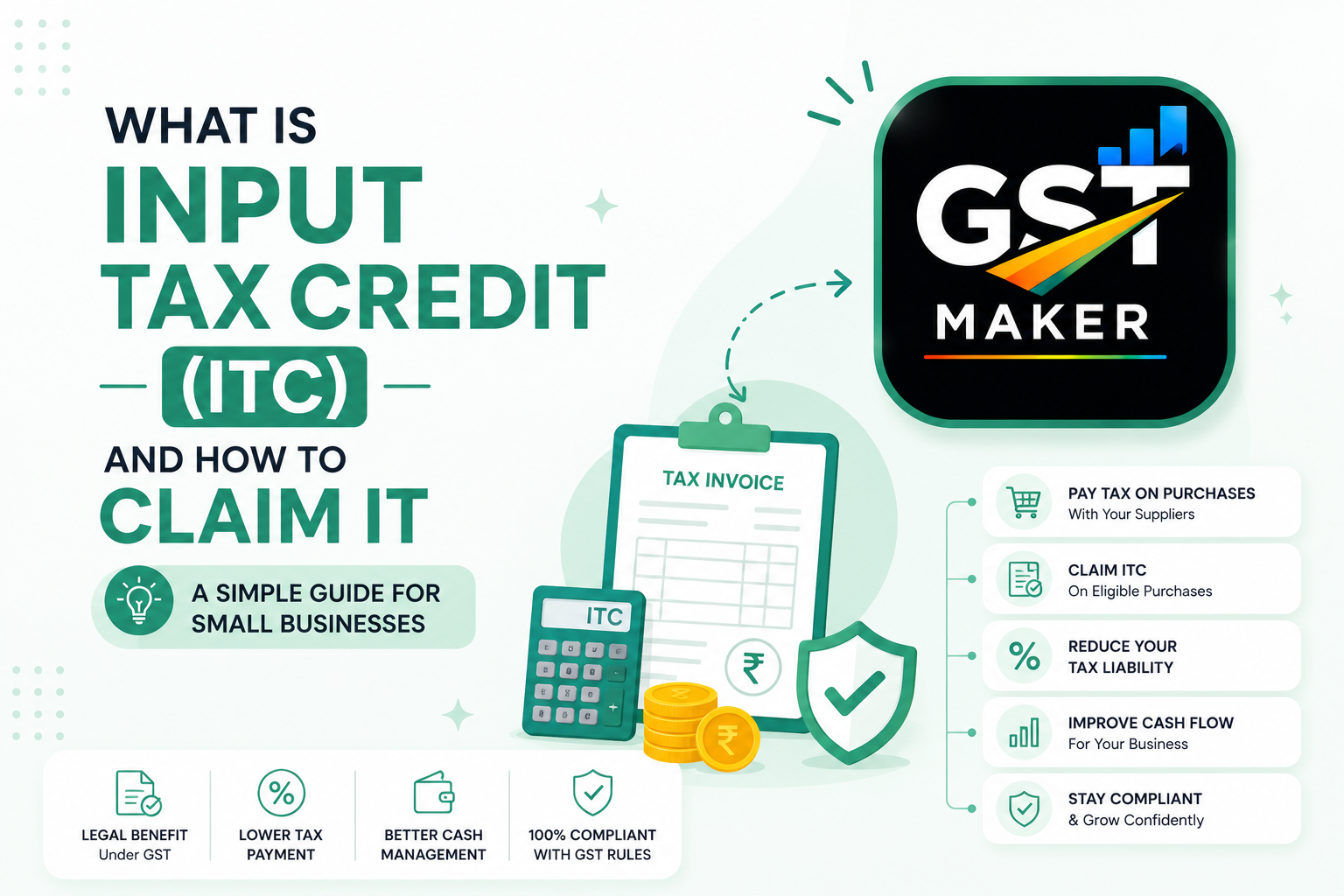
If you're a GST-registered business in India, there's one benefit sitting right there that can save you real money every month — Input Tax Credit, or ITC.
And yet most small business owners either don't know it exists, half-understand it, or find the rules confusing enough that they just don't bother claiming it. That's genuinely money left on the table, month after month.
So here's ITC explained as simply as I can manage — what it is, how it works, who qualifies, and what you actually need to do to claim it.
What ITC actually is
Let's use an example instead of a definition.
Say you run a small design agency. You buy a laptop for ₹1,20,000, and the seller charges 18% GST on top — ₹21,600 in tax.
Now, over the month, you do design work for clients and charge them GST too. Say you collected ₹30,000 in GST from them.
Without ITC, you'd deposit the full ₹30,000 with the government.
With ITC, you subtract the ₹21,600 you already paid on the laptop. So you only deposit ₹30,000 − ₹21,600 = ₹8,400.
That ₹21,600 you already paid on a business purchase — that's your Input Tax Credit. It reduces what you owe.
Put simply: ITC means you don't pay GST twice. The tax you pay buying something for the business gets adjusted against the tax you collect from your own customers.
Why this exists at all
GST is designed to tax the final consumer, not every business sitting in between on the supply chain.
Without ITC, everyone in that chain would pay full GST — the manufacturer pays, then the wholesaler pays again, then the retailer pays again. By the time it reaches the customer, the same value has been taxed multiple times over.
ITC stops that from happening. Each business only pays tax on the value it actually adds, not the full price. This is the value-added tax principle, and it's basically the whole foundation GST runs on.
Who's actually eligible to claim it
A few conditions have to be met, and they're worth knowing before you assume you qualify.
You need to be GST registered. No registration, no ITC — full stop. This alone is why plenty of businesses register voluntarily even below the turnover threshold.
You need a proper tax invoice. The supplier has to have given you a real GST invoice — their GSTIN, your GSTIN, tax breakup, all clearly stated.
Your supplier needs to have actually filed their return. This is the part that trips people up. Your ITC only holds if the supplier uploaded that invoice in their GSTR-1 and paid the tax. Supplier hasn't filed? Your claim can get rejected, even if you did everything right on your end.
It has to be for business, not personal use. Buy a phone for yourself, no ITC. Buy it for the business, ITC applies.
You need to file your own returns on time. Miss your GSTR-3B deadline, and ITC claims can lapse.
What you can actually claim on
Most business purchases and expenses where GST was charged — raw materials, equipment, office supplies, software subscriptions, professional fees (legal, accounting, consulting), advertising and marketing, and business travel with some restrictions.
The rough rule of thumb: bought it for the business, paid GST on it — you can probably claim it.
What you can't claim on
Some things are blocked outright, no matter how legitimately you paid the GST. These fall under Section 17(5) of the CGST Act, and the big ones to know are:
Food and beverages — restaurant bills, office catering — generally not claimable unless you're actually in the food business yourself.
Personal vehicles — GST on buying a car doesn't count for most businesses, unless you're specifically in the business of selling, renting, or transporting using those vehicles.
Construction of immovable property — building an office or warehouse means the GST on construction materials isn't claimable.
Employee health insurance — GST on those premiums is blocked too.
Club memberships and vacation packages — these read as personal, so no claim.
If you're ever unsure whether something qualifies, just check with a CA — cheaper than guessing wrong.
How you actually claim it
There's no separate application for this — it happens right inside your regular return filing.
Collect real invoices for everything you buy. Supplier's GSTIN, your GSTIN, invoice number, date, GST breakup — all of it needs to be there.
Check GSTR-2B every month. This is an auto-generated statement showing every invoice your suppliers have uploaded against your GSTIN. Before you claim anything, make sure the invoices you actually received are showing up here. If a supplier hasn't filed, the invoice simply won't appear — and claiming ITC on it anyway is how mismatches happen.
Reconcile your own records against it. Match what you have to what GSTR-2B shows. Anything missing, follow up with the supplier and get them to file.
Claim it in GSTR-3B. When you file your monthly return, ITC goes in Table 4. It adjusts against what you owe automatically — you only pay the difference.
A real example
Say you're a freelance web developer. In April, you:
- Collected ₹50,000 in GST from clients
- Paid ₹9,000 GST on a software subscription
- Paid ₹3,600 GST on a keyboard and mouse
- Paid ₹1,800 GST on domain and hosting
That's ₹14,400 in ITC available. So instead of paying the full ₹50,000, you owe ₹50,000 − ₹14,400 = ₹35,600.
Same month, same work — ₹14,400 saved just by claiming what you were already owed.
Mistakes that cost people this money
Not collecting invoices in the first place — no valid GST invoice means no ITC, so always ask for one.
Trying to claim on blocked items — food bills, personal vehicles, club memberships — this doesn't fly and can invite penalties during an audit.
Skipping the GSTR-2B check — claiming on invoices your supplier never filed is a risky habit, verify first.
Missing the deadline — ITC on any invoice has to be claimed by November 30th of the following financial year, or before the annual return is filed, whichever comes first. Miss that window, and it's gone.
Where GST Maker fits in
GST Maker keeps your invoices and billing records organized in one place, so when it's time to file, your outward supply data is already clean — which makes the whole ITC reconciliation faster.
It also means your customers can claim their ITC smoothly off your invoices, which makes you a more reliable vendor to work with, honestly.
If you're not using a proper GST billing tool yet, this is a good reason to start. Try it free at gstmaker.com.
Last word
ITC is one of the genuinely good parts of being GST registered — it's the government essentially saying the tax you paid on business expenses comes back to you.
But it only works if you keep clean records, collect valid invoices, and file on time. Get those three things right consistently, and ITC pretty much takes care of itself.