AI Article Assistant
Ask questions, summarize, or extract key takeaways from this article.
What is e-Invoicing Under GST? Who Needs It and How Does It Work in 2026
If you've been keeping half an eye on GST news lately, you've probably run into the term "e-invoicing" a fair bit. The government keeps expanding it, more businesses get pulled in every year, and there's another change landing in June 2026.
But a lot of small business owners and freelancers still have the same basic question — what actually is this, do I need it, and how does it work?
Let's clear that up.
What e-invoicing actually is
First, let's kill a common misunderstanding. e-invoicing has nothing to do with making your invoice in Excel or sending it over email. That's not the government's definition at all.
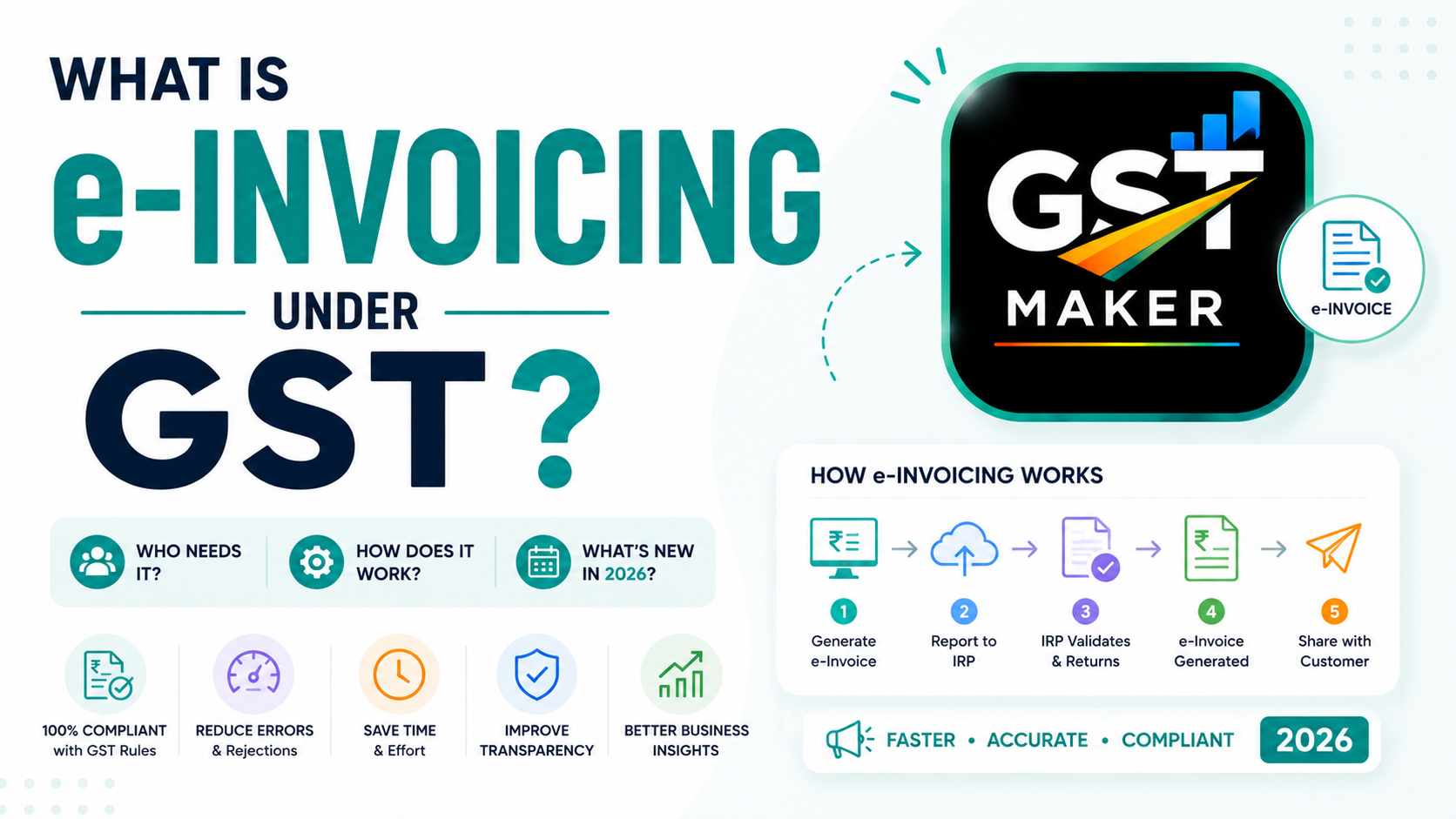
e-invoicing under GST means you generate your invoice, and then register it on the government's Invoice Registration Portal (IRP). The IRP checks it and hands back a unique IRN (Invoice Reference Number) and a QR code. Only after that registration is the invoice actually considered valid for GST purposes.
The easiest way to think about it — you make the invoice like you always have, but now you need it "stamped" by the government portal before it goes to your customer. The IRN and QR code are that stamp.
Why this exists in the first place
Mainly, to cut down on fraud and fake invoices.
Before e-invoicing, a business could create pretty much any invoice they wanted, and the government had no real-time way to check it. Some businesses used this to generate fake invoices purely to claim input tax credit they weren't owed.
Now, every B2B invoice gets registered and validated on the government's system before it can be used anywhere. That creates a paper trail that's genuinely hard to fake.
There's a practical upside for businesses too — once your invoice is registered on the IRP, the data flows straight into your GSTR-1 automatically. Less manual entry, fewer chances to slip up.
Who actually needs this right now
The rollout has happened in phases, starting with the biggest businesses and slowly working down.
As of 2026, e-invoicing is mandatory for anyone with annual turnover of ₹5 crore or more.
Here's how the threshold has moved over the years:
- October 2020 — above ₹500 crore
- January 2021 — above ₹100 crore
- April 2021 — above ₹50 crore
- October 2022 — above ₹10 crore
- August 2023 — above ₹5 crore
Below ₹5 crore, it's not mandatory for you yet. But given how consistently this threshold has dropped, it's worth understanding now rather than scrambling to figure it out later.
Who's exempt
Even above ₹5 crore, a few categories skip e-invoicing entirely — banks and financial institutions, insurance companies, Goods Transport Agencies, passenger transport services, SEZ businesses, and government departments.
Also worth knowing — this whole system currently applies only to B2B transactions, meaning sales between two registered businesses. Selling directly to end consumers (B2C)? None of this applies to those invoices.
What's changing in 2026 — the Ship-To GSTIN update
Here's the change actually worth paying attention to. The GSTN portal is making the "Ship To GSTIN" field mandatory for Bill-To / Ship-To transactions, going live June 15, 2026.
In plain terms — when your billing address and delivery address are different (extremely common in B2B), you'll now have to mention the GSTIN of wherever the goods are actually delivered, not just wherever the invoice is billed to.
This matters most if you're shipping goods to a different branch or warehouse than the one on the invoice. It used to be optional. From June 2026, it isn't. If you're using any ERP or billing tool, worth double-checking it supports this before the deadline hits.
How the process actually works
Nothing complicated, just five steps.
1. Generate the invoice — as usual, customer details, items, GST amounts, all of it, in your billing software.
2. Upload to the IRP — your software sends the invoice data across, either directly or through a GST Suvidha Provider.
3. IRP validates it, sends back an IRN and QR code — checks for errors, validates GSTINs, and if it's all correct, generates the IRN and signed QR code. Usually happens in seconds.
4. Send it to your customer — with the IRN and QR code now added on. Without an IRN, it's simply not a valid invoice.
5. It auto-populates your GSTR-1 — no manual re-entry needed.
What happens if you skip it when you're required to do it
If you're above ₹5 crore and not generating e-invoices, the consequences are real, not theoretical:
- Your invoice isn't legally valid under GST
- Your customer can't claim input tax credit on it
- You're exposed to penalties under the GST Act
- Non-compliant invoices tend to trigger demand notices during audits
Not something to put off if you're above the threshold.
Does GST Maker handle this?
If your turnover is close to or above ₹5 crore, it's worth checking the e-invoicing capabilities of whatever tool you're using. Most small businesses and freelancers on GST Maker are well under that number, so it's not something you need to worry about today.
Still, understanding the system is genuinely useful. The threshold dropped from ₹500 crore to ₹5 crore in just a handful of years — there's a decent chance it keeps coming down.
Should small businesses care right now?
Under ₹5 crore, you don't need to implement anything today. But a few reasons it's still worth understanding:
The threshold keeps shrinking. ₹500 crore to ₹5 crore in a few years is a fast drop, and plenty of people expect it to eventually cover every registered business. Getting comfortable with the concept early beats a last-minute scramble.
Bigger customers may expect it. If you're supplying businesses that are already above the threshold, they might ask questions about your invoicing process — knowing how the system works just makes that conversation easier.
It genuinely simplifies filing. Once you're on e-invoicing, GSTR-1 basically fills itself. Less manual work, fewer mistakes.
Bottom line
e-invoicing is the government pushing for more transparency and automation across GST. Above ₹5 crore, it's mandatory today. Below it, it's probably coming your way at some point.
The smartest move right now is understanding how it works, using a billing tool that actually stays current with GST changes, and keeping your invoicing clean regardless of where you sit on the threshold.
GST Maker is built to track GST rule changes so you don't have to chase every update yourself. Head to gstmaker.com and keep your billing simple, accurate, and compliant.