AI Article Assistant
Ask questions, summarize, or extract key takeaways from this article.
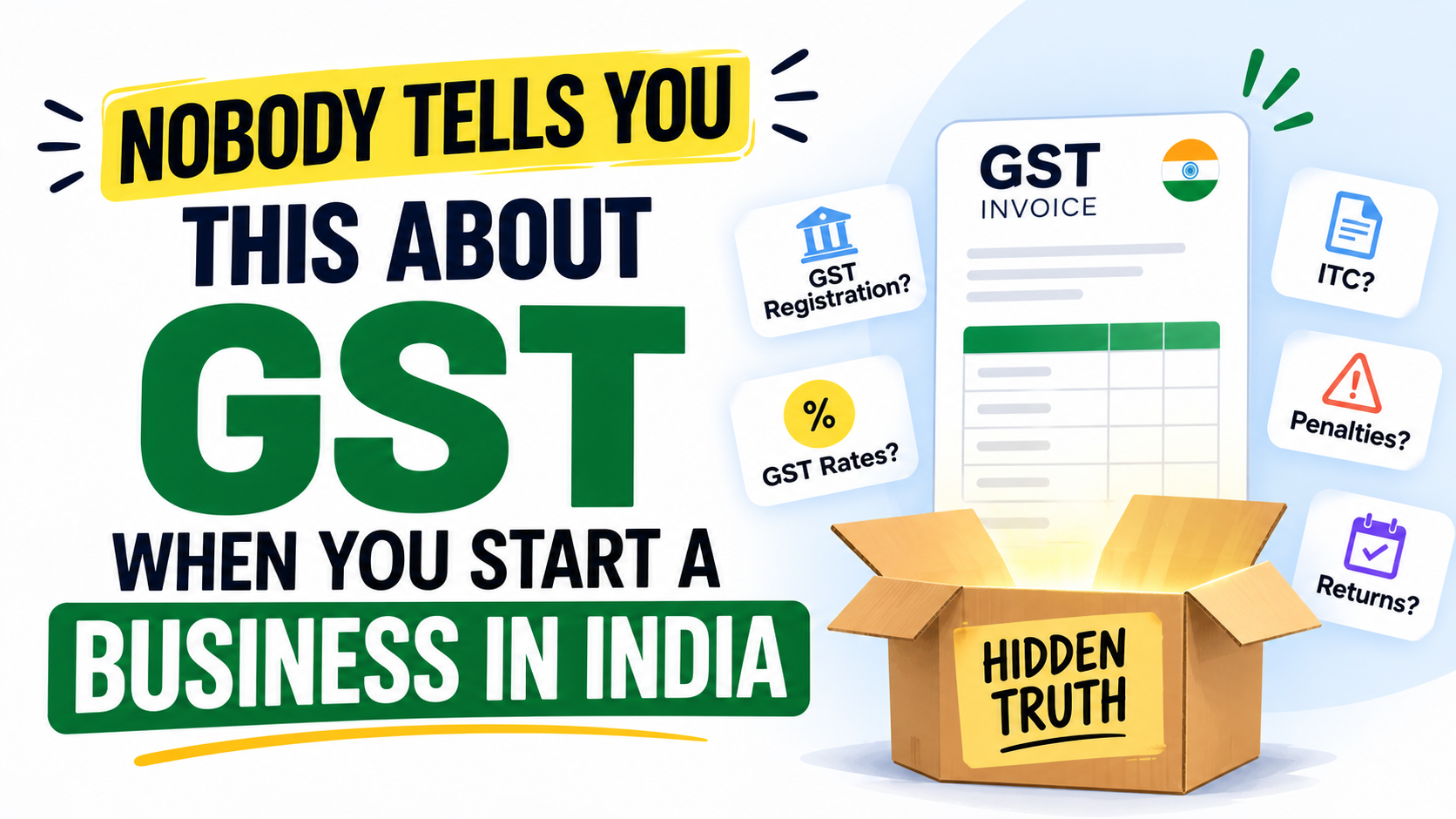
Nobody Tells You This About GST When You Start a Business in India
When you start a business in India, everyone gives you advice.
Register your company. Open a current account. Get a PAN. Build a website. Find clients.
But GST? Nobody really sits you down and explains it properly. You figure it out piece by piece — usually after making a mistake that costs you money or a client relationship.
I have had hundreds of conversations with small business owners since we started building GST Maker. And the same things come up again and again. Things people wish someone had told them at the beginning.
So here they are. Bluntly.
You Do Not Always Need to Register for GST Immediately
This surprises a lot of people.
If you are a service provider and your annual income is below ₹20 lakhs — you are not legally required to register for GST. If you sell goods, the threshold is ₹40 lakhs.
Most new freelancers and small business owners rush to get a GSTIN because someone told them they need one. Sometimes that is true. Often it is not — at least not yet.
The exception that catches people off guard: if you sell on Amazon, Flipkart, or any e-commerce platform — GST registration is mandatory regardless of your turnover. Day one. No threshold.
And if your clients are registered businesses who need to claim ITC on your invoices — you might want to register voluntarily even below the threshold. Because without your GSTIN on their invoice, they cannot claim ITC, and some corporate procurement teams will simply not work with unregistered vendors.
So the real answer to "do I need GST registration?" is — it depends. On how much you earn, how you sell, and who your clients are.
Your Invoice is a Legal Document. Most People Do Not Treat It That Way.
A WhatsApp message with the amount is not an invoice.
A Word document with your name and the client's name and a number at the bottom — technically not a compliant GST invoice either, if it is missing the GSTIN, SAC code, place of supply, sequential invoice number, and proper tax breakup.
This matters because your invoices are what the government uses to verify your income during a GST audit. If your records are a mess — different formats, missing fields, no numbering system — you are creating a problem for future you.
I have spoken to small business owners who received GST notices specifically because their invoice records did not match their bank deposits. Not because they were hiding anything. Just because nobody had told them that invoices need to follow a specific format.
The CGST vs IGST Thing Will Bite You Eventually
Everyone who has billed clients across states has made this mistake at least once.
You charge a client in Delhi. You are in Mumbai. You put CGST + SGST on the invoice because that is what you always do. The client's accounts team calls — their ITC claim failed because of wrong tax type.
The rule is simple once you know it. Same state — CGST + SGST. Different state — IGST. But in the rush of creating invoices, it gets forgotten.
We built the automatic detection in GST Maker specifically because this kept coming up in conversations. People were not being careless. They were just busy — and the tool they were using required them to make this decision manually every single time.
If you bill clients in multiple states and you are still deciding this manually — at some point you will get it wrong. It is not a question of if. It is when.
GSTR-1 and GSTR-3B Are Not the Same Thing. Filing One is Not Enough.
A lot of new business owners learn this the hard way.
GSTR-1 is where you report your sales — every invoice you raised that month.
GSTR-3B is where you actually pay your tax — after adjusting ITC.
You need to file both. Every month (or every quarter if you are on the QRMP scheme). Missing either one starts the late fee clock immediately.
The confusion usually happens in the early months. Someone files GSTR-3B, pays their tax, and thinks they are done. Then they get a notice saying GSTR-1 was not filed. Or they file GSTR-1 and forget GSTR-3B. Either way — late fees and a headache.
Set two separate reminders. 11th of the month for GSTR-1. 20th for GSTR-3B. Do not combine them in your head as "filing returns." They are different documents with different deadlines.
Input Tax Credit is Real Money. Most People Leave it on the Table.
The GST you pay on your business expenses — software, equipment, office rent, professional fees — can be claimed back against the GST you collect from clients.
Most small businesses claim maybe half of what they are entitled to. The rest gets lost because nobody kept the bills, or the supplier did not file their return, or the ITC was just not tracked properly.
Here is what a typical freelancer or small agency is missing every month: - Software subscriptions — GST paid, claimable - Co-working space — GST paid, claimable - Advertising spend — GST paid, claimable - Equipment purchases — GST paid, claimable - Professional services — GST paid, claimable
Over a year, this adds up to real money. ₹30,000, ₹50,000, sometimes more. Not in refund — as a reduction in what you owe when you file.
The only way to capture it is to record expenses as they happen. Not at month end. Not when your CA asks. The same day you pay.
Your CA Cannot Fix Bad Records. They Can Only Work With What You Give Them.
People assume their CA will sort everything out. And a good CA absolutely helps — with compliance, with filing, with tax planning.
But if your invoice records are scattered across three apps, a notebook, and your WhatsApp — your CA is not going to reconstruct them. They will do their best with what you provide. And if what you provide is incomplete, your returns will be incomplete.
The responsibility for maintaining proper invoice records sits with you. Not your CA.
This is actually why we built GST Maker the way we did — not just to generate invoices, but to automatically maintain records, organise data for GSTR-1, and make the information your CA needs available with one click.
Your CA should be spending their time on strategy and planning. Not on hunting for your March invoice to XYZ company.
Late Fees Are Not a Warning. They Are Immediate.
There is no grace period for GST filing.
The due date passes. The late fee starts. ₹50 per day per return. If you have two returns due and you are 15 days late on both — that is ₹1,500 in late fees. For missing a deadline.
And the interest on unpaid tax — 18% per annum — is not capped. On ₹1 lakh of unpaid GST, that is ₹1,500 per month in interest. Every month until you pay.
These are not huge amounts individually. But they accumulate quietly. And the worst part is — they are entirely avoidable.
The discipline of filing on time is not about being a good taxpayer. It is about not throwing money away on completely avoidable penalties.
One Last Thing Nobody Says Out Loud
Most of the GST compliance problems small businesses face are not complicated. They are just ignored for too long.
A missing invoice number. A wrong GST type. An expense not recorded. A return filed a week late. None of these are disasters individually.
But combined — over months and years — they create a compliance picture that is messy, expensive to clean up, and stressful when the government eventually notices.
The businesses that stay out of trouble are not the ones with the best CAs or the most sophisticated accounting setups. They are the ones that get the basics right, consistently, from day one.
Invoice on time. Record expenses when they happen. File returns before the deadline. Use a tool that handles the GST calculations automatically so you never have to think about CGST vs IGST.
That is genuinely all there is to it.
👉 GST Maker is free and takes 4 minutes to set up — gstmaker.com
Start there. Sort the rest as you grow.