AI Article Assistant
Ask questions, summarize, or extract key takeaways from this article.
GST Return Filing — A Simple Guide for Small Businesses and Freelancers
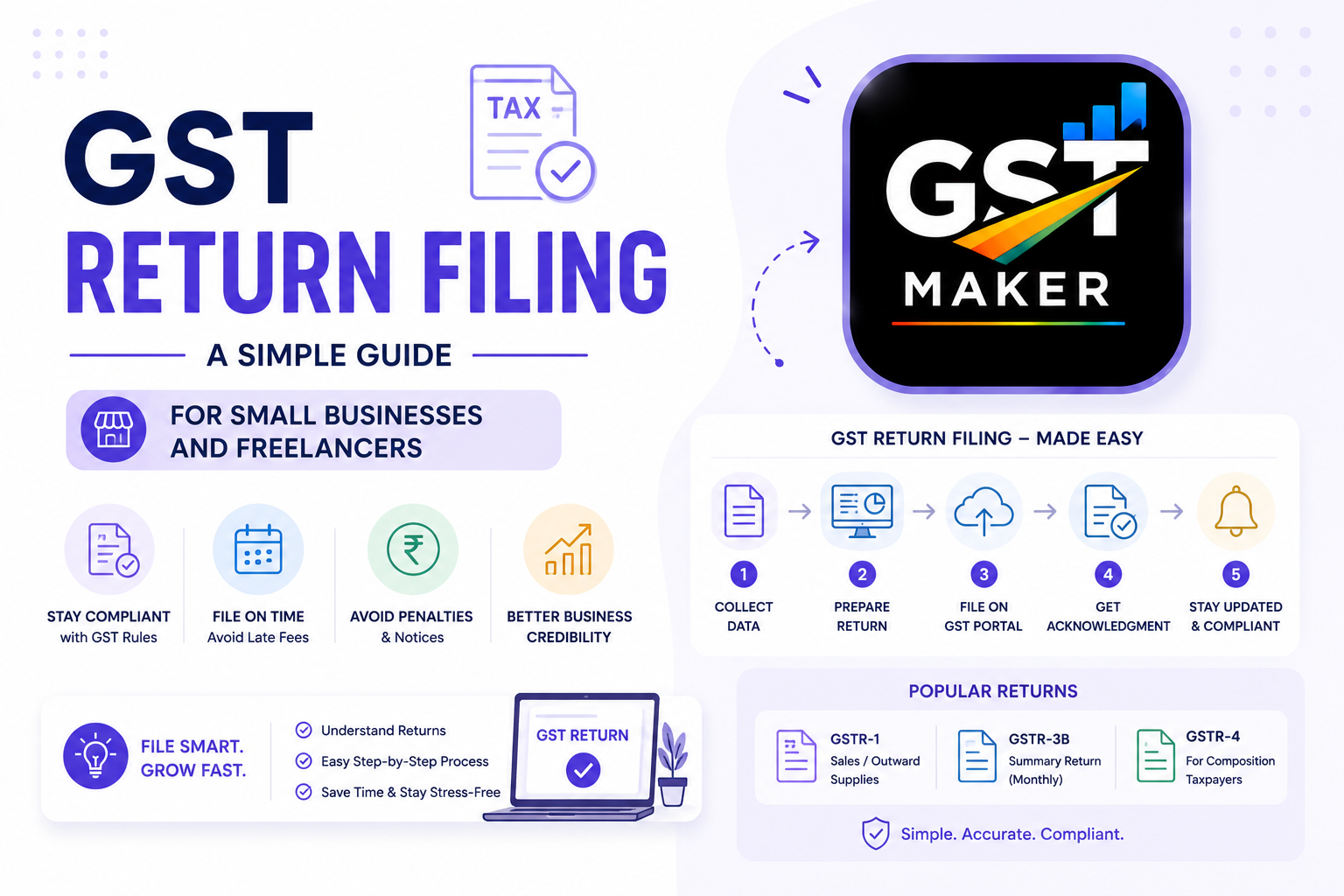
If there's one thing that confuses GST-registered business owners more than anything else, it's return filing. GSTR-1, GSTR-3B, GSTR-9, monthly vs quarterly — just the names are enough to make your head spin before you've even started.
But here's the truth — once you get the basics down, it's really not that complicated. It's just telling the government what you sold, what you bought, and how much tax you owe or already paid.
So let's break it down properly. No accounting degree required.
What actually is a GST return?
Basically, it's a report you file with the government. It tells them how much you sold, how much you bought for the business, how much GST you collected, how much you paid on purchases (your ITC), and what you owe once that's all adjusted.
Every registered business has to file these regularly — monthly or quarterly, depending on turnover. Zero sales in a month? You still file a nil return. There's no skipping it.
The two returns that actually matter day-to-day
There are several types of GST returns out there, but for most small businesses and freelancers, only two come up regularly.
GSTR-1 — your sales report
This is where every invoice you raised in the month or quarter gets reported — B2B, B2C, exports, all of it.
It matters more than people realize, because once your invoices show up here, your customers see them in their GSTR-2B and can claim ITC. Delay this filing, and your customers get stuck, unable to claim their credit — which is exactly the kind of thing that creates friction in a business relationship you'd rather keep smooth.
Due date: 11th of the following month for monthly filers, 13th of the month after the quarter for quarterly filers.
GSTR-3B — your actual tax payment
This is the summary return — total sales, total ITC, and the tax you actually pay. This is where money moves. You work out your net liability after ITC and pay the balance.
If GSTR-1 is the detailed report, GSTR-3B is the bill.
Due date: 20th of the following month for most businesses. Some under ₹5 crore get an extended window — 22nd or 24th, depending on the state.
GSTR-9 — the annual return
Filed once a year, this rolls up everything you reported across GSTR-1 and GSTR-3B for the whole financial year. Think of it as an annual audit of your own compliance.
Due date: December 31st of the following financial year. So FY 2025-26's GSTR-9 is due December 31, 2026.
Mandatory above ₹2 crore turnover. Below that, optional — but still worth doing.
Monthly or quarterly — which one are you?
This is where a lot of small businesses get tripped up.
Above ₹5 crore turnover? Monthly filing, no option to skip it.
Below ₹5 crore? You can opt into the QRMP scheme — Quarterly Return Monthly Payment. GSTR-1 and GSTR-3B get filed once every three months, but you still pay tax monthly through a simple challan. It cuts your returns from 24 a year down to 8, which is a real relief once you've felt what filing monthly is actually like.
If you're under ₹5 crore and haven't switched to QRMP yet, it's a quick setting on the GST portal.
Filing GSTR-3B, step by step
1. Log in at gst.gov.in with your GSTIN and password.
2. Go to Returns Dashboard, under Services, and pick the financial year and return period.
3. Check your GSTR-2B first. This shows every purchase invoice your suppliers have uploaded — it's your available ITC for the month.
4. Fill in GSTR-3B — outward sales, tax collected, ITC details. The portal calculates your net liability for you.
5. Pay whatever's owed through your electronic cash ledger — net banking, UPI, NEFT, whatever's easiest.
6. Submit and file, using either your DSC or an EVC (basically an OTP).
That's genuinely the whole process. Nothing hidden beyond that.
What actually happens if you miss a deadline
Late fee — ₹50 a day for a delayed GSTR-3B (₹25 CGST + ₹25 SGST), or ₹20 a day if it's a nil return.
Interest — 18% per annum on any unpaid tax if you're late. This adds up faster than people expect.
Your customers get stuck — a delayed GSTR-1 means your customers can't see your invoices in their GSTR-2B, so their ITC gets blocked. Not great for the relationship.
Repeated misses can suspend your GSTIN — and getting it reinstated is a genuinely long, painful process.
Filing on time, every time, is really the only way to avoid all of this.
Mistakes people keep making here
Mismatches between GSTR-1 and GSTR-3B — the sales figures in both need to line up, or the system flags it and you could get a notice.
Claiming ITC without checking GSTR-2B first — claiming based on your own invoices without verifying the supplier actually uploaded them is how mismatches happen.
Forgetting nil returns — zero sales doesn't mean zero filing. Plenty of people skip this thinking there's nothing to report, and the small late fee still applies.
Wrong customer GSTIN on an invoice — get this wrong, and it won't reflect properly in their GSTR-2B. Worth double-checking before you raise the invoice, not after.
Where GST Maker actually helps
The hard part of filing isn't the portal itself — it's having clean, organized invoice data ready when you need it.
That's the piece GST Maker takes care of. Every invoice gets stored and organized as you create it, so by the time the month ends, your sales data is already sitting there — no digging through WhatsApp chats or hunting down Excel files.
It generates GSTR-1 ready reports you can use directly — invoice numbers, dates, customer GSTINs, taxable values, tax amounts, all in the right format already.
Less manual work, fewer mistakes, faster filing.
Deadlines at a glance
| Return | Frequency | Due Date |
|---|---|---|
| GSTR-1 (monthly) | Monthly | 11th of next month |
| GSTR-1 (quarterly) | Quarterly | 13th of month after quarter |
| GSTR-3B (monthly) | Monthly | 20th of next month |
| GSTR-3B (quarterly) | Quarterly | 22nd or 24th of month after quarter |
| GSTR-9 (annual) | Yearly | December 31st |
Set reminders for these. Missing them by even a single day starts the late fee clock.
Bottom line
GST return filing sounds like a lot the first time you hear about it. But once it clicks that it's really just two things — reporting sales, paying net tax — it stops feeling so heavy.
The trick is staying organized through the month so filing day isn't a scramble. Use a decent billing tool, keep invoices clean, check GSTR-2B before claiming ITC, and file before the deadline.
That's genuinely all there is to it.
If you want your GST billing and return prep to be this easy, try gstmaker.com for free.