AI Article Assistant
Ask questions, summarize, or extract key takeaways from this article.
GST Invoice vs Non-GST Invoice — What is the Difference and When to Use Which
If you run a small business or freelance in India, you've probably wondered at some point — should this be a GST invoice or a regular one? What's actually different between them? And what happens if you pick the wrong one?
Fair questions, and honestly, the answer is simpler than most people expect.
Here's exactly what a GST invoice is, what a non-GST invoice is, when each one applies, and the mistakes that trip people up.
What's a GST invoice?
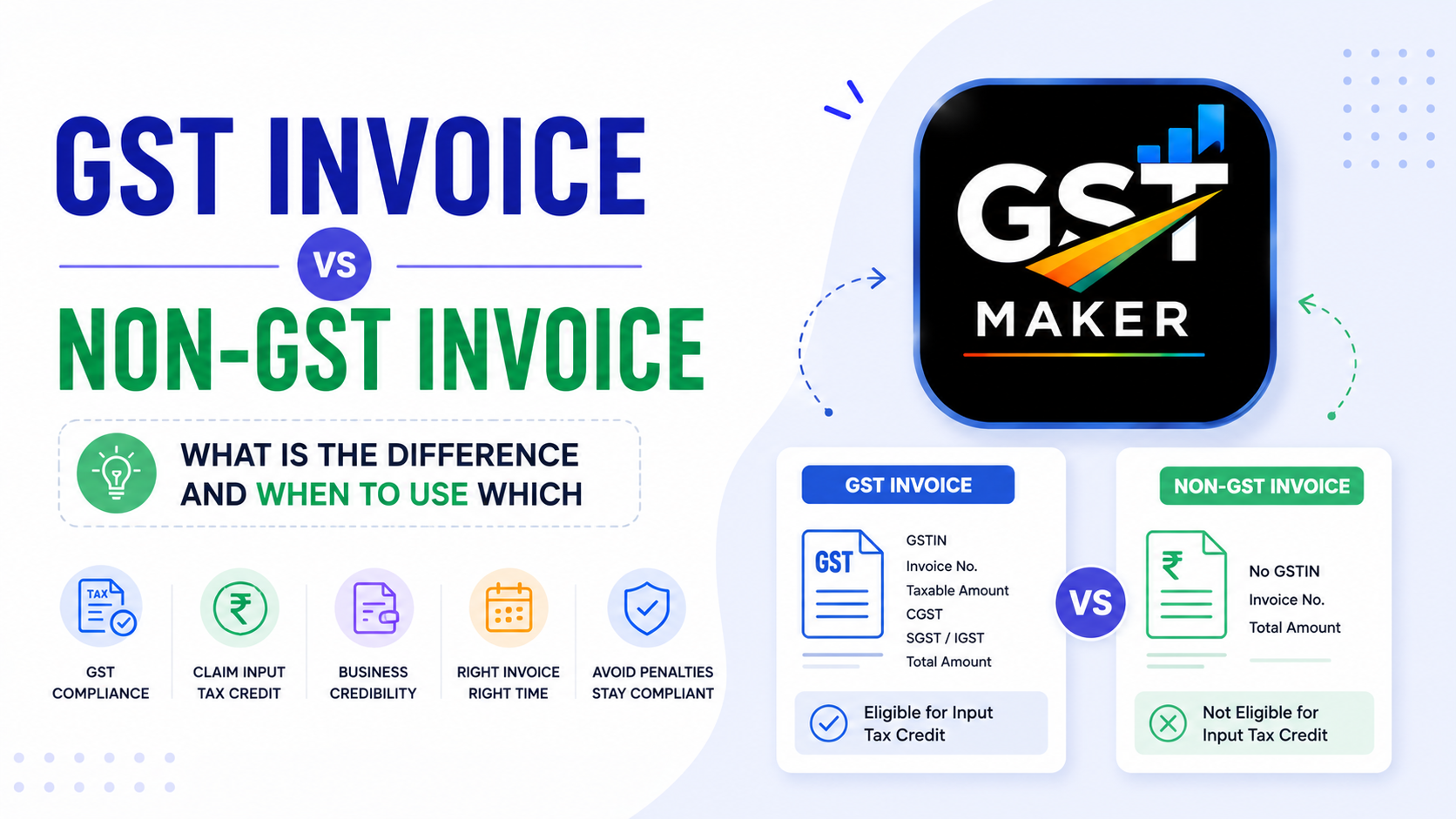
It's a formal billing document from a business registered under GST. It has all the standard stuff — your name, customer details, what you sold, the price — plus GST-specific bits: your GSTIN, HSN or SAC code, and the tax breakup (CGST, SGST, or IGST).
The moment you issue one of these, you're legally collecting tax on the government's behalf. That amount has to get deposited when you file your returns.
It also lets your customer — assuming they're a registered business — claim that tax back as input tax credit. For B2B work, this matters a lot more than people realize.
What's a non-GST invoice?
Sometimes called a simple invoice or a bill of supply. No GST anywhere on it — no GSTIN, no tax breakup, just the basic transaction details.
This is what unregistered businesses use. Below the turnover threshold and haven't registered? Every invoice you send is this kind.
There's also a specific document called a Bill of Supply, which registered businesses use for GST-exempt goods or services, or if they're under the composition scheme. Technically it's a different document from a plain non-GST invoice, but for most small businesses the practical result is the same — no GST charged either way.
The difference, quickly
GST invoice — only from registered businesses, includes GSTIN and tax breakup, GST added on top of the price, customer can claim ITC, required for taxable sales past the threshold.
Non-GST invoice — from unregistered businesses, no GSTIN or tax lines, just the base price, no ITC for anyone, used below the threshold or for exempt goods/services.
When you should be sending a GST invoice
If you're registered, there's actually no choice in the matter — every taxable sale needs a GST invoice. Send a plain one instead, and you're not compliant, simple as that.
If your customer is a registered business, they'll almost always want a GST invoice anyway, since it's how they claim their own ITC. Registered seller, registered buyer — always go with the proper GST invoice.
And unless what you're selling is specifically exempt, most goods and services in India attract GST once you're registered, so this is the default, not the exception.
When a non-GST invoice makes sense
Not registered under GST? Below ₹20 lakh for services or ₹40 lakh for goods, and haven't signed up yet? Then you legally can't charge GST — send the plain invoice, just the amount, nothing else.
Selling something exempt — fresh vegetables, milk, eggs, educational services, healthcare — means you issue a Bill of Supply instead, even if you're registered.
Same goes if you're under the composition scheme. Flat tax, no GST charged to customers, Bill of Supply it is.
Mistake one — charging GST without being registered
This happens more than you'd expect. A new freelancer sees GST invoices from other people, assumes they need to match that, and starts adding a GST line to their own invoices — without actually having a GSTIN.
That's a real problem. You're collecting money that's supposed to go to the government, but you have no legal way to deposit it. Show up in an audit, and this is exactly the kind of thing that leads to penalties.
The rule really is that simple — no GSTIN means no GST line, period.
Mistake two — the opposite problem
Some businesses get their GSTIN and then just... keep sending the old invoice format. Forget to update anything.
Once you're registered, every taxable sale needs a proper GST invoice. Sticking with the old plain version after registration is non-compliance too, and it'll create mismatches when you file returns.
The fix is easy — the day you get your GSTIN, update your invoice template. On GST Maker, that's literally just adding your GSTIN to your profile — everything you generate after that is automatically GST-compliant.
What about clients outside India?
Slightly different rules if you're doing freelance or agency work for foreign clients.
Services you export are zero-rated under GST — 0% tax, so you don't charge your foreign client anything. But if you're registered, you still need to issue an export invoice showing your GSTIN and marked clearly as an export of services.
That's an important distinction — this isn't the same as a non-GST invoice. It's still a GST invoice, just at 0%. And that distinction actually matters for your return filing and any ITC refund you go on to claim.
How GST Maker handles both situations
Registered or not, GST Maker works either way.
Registered? Your GSTIN sits in your profile and auto-fills on everything. CGST/SGST vs IGST gets applied automatically based on where your customer is, and SAC/HSN codes stay saved against each product so you never look them up twice.
Not registered yet? You can still create clean, professional invoices with no GST lines at all. And the day you do register, you just update your profile — every invoice from there shifts to the GST format automatically.
No new tool to learn, no switching platforms halfway through your business's growth. Same system, both stages.
Bottom line
It's not really a choice between GST invoice and non-GST invoice — it just depends on whether you're registered, and whether what you're selling is taxable.
Registered — use GST invoices for taxable sales. Not registered — plain invoices, no tax. Registered but selling exempt goods — Bill of Supply.
Get this straight early and you'll save yourself a lot of trouble come filing season and audits.
If you want something that handles the right invoice format automatically based on your registration status, try gstmaker.com — it's free.