AI Article Assistant
Ask questions, summarize, or extract key takeaways from this article.
GST Billing for Transporters and Logistics Companies in India — Complete Guide
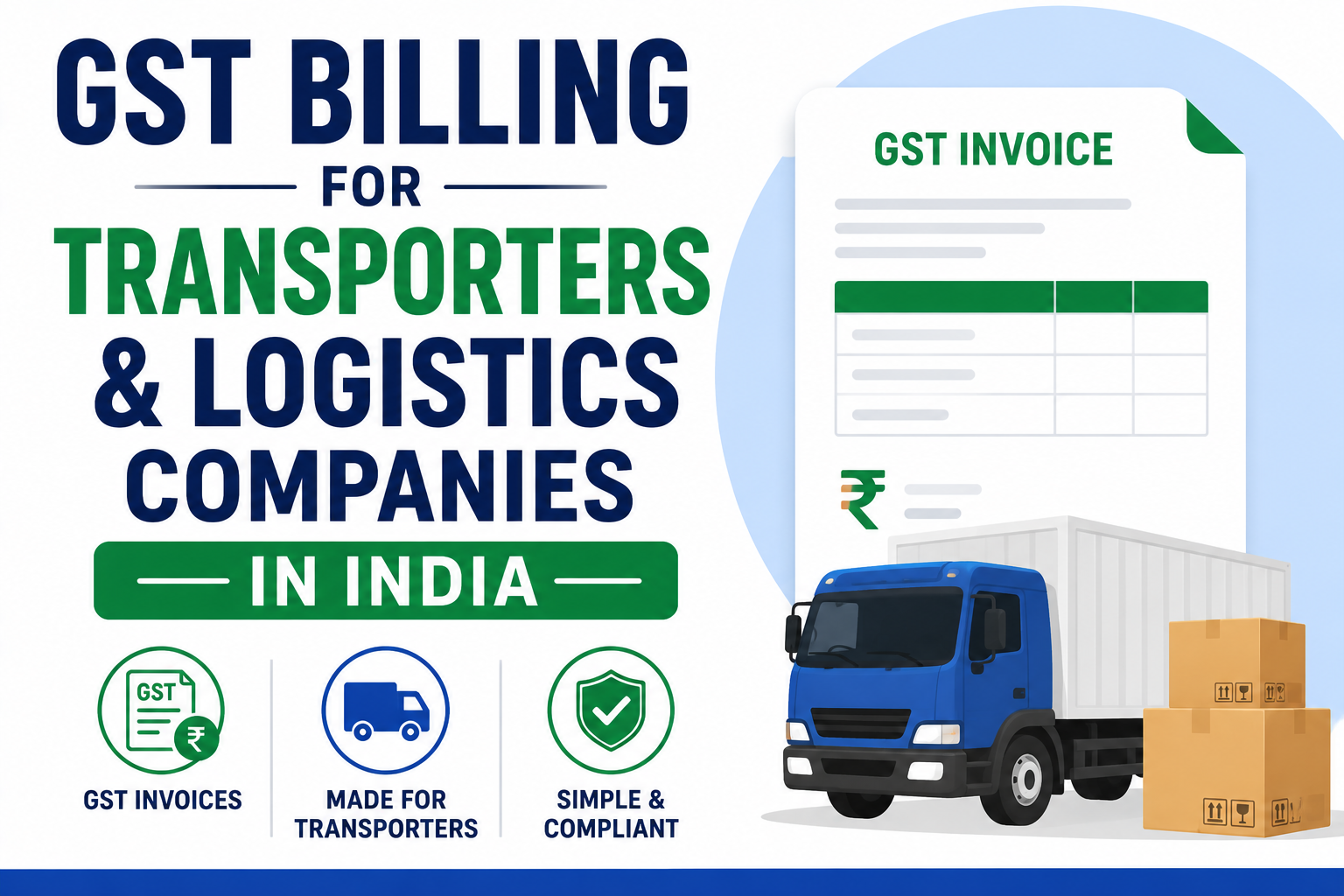
India moves on trucks. Raw materials heading to a factory, finished goods reaching a warehouse, packages landing on someone's doorstep — the whole economy runs on this.
But for truck owners, fleet operators, freight forwarders, courier companies, and logistics providers, GST compliance is genuinely one of the more complicated corners of the law. GTA rules, reverse charge, e-way bills, different rates for different transport modes — there's a lot to actually get right.
Here's the key GST rules for transporters and logistics businesses in India, and how GST Maker helps with the billing side of it.
The rule that changes everything — GTA and reverse charge
If you're a Goods Transport Agency — providing road transport of goods using a goods carriage — GST works differently for you than for almost any other business.
Under the Reverse Charge Mechanism, the recipient of your service pays the GST, not you. So if a registered business hires you to transport goods, they pay the GST on the transport charge, not you as the GTA — you don't collect it from them at all. They deposit it directly and claim ITC on it themselves.
If the recipient is unregistered or an individual, though, you may need to collect and pay the GST yourself.
Where GST does apply to a GTA directly, it's either 5% with no ITC (the more common setup) or 12% with ITC, if you've specifically opted to pay GST yourself instead of relying on RCM.
Rates across different transport services
Transport isn't one flat rate across the board — it varies by mode and type:
| Transport Service | SAC Code | GST Rate |
|---|---|---|
| Road transport by GTA (reverse charge) | 996511 | 5% or 12% |
| Courier and parcel delivery services | 996812 | 18% |
| Air freight (domestic) | 996531 | 18% |
| Air freight (international) | 996531 | 18% |
| Rail transport of goods | 996512 | 5% |
| Sea/waterway transport | 996521 | 5% |
| Transport of passengers by road | 996411 | Exempt (auto, taxi) / 5% (AC bus) |
| Warehousing and storage | 996719 | 18% |
| Freight forwarding services | 996719 | 18% |
| Packing and moving services | 996791 | 18% |
| Last-mile delivery services | 996812 | 18% |
| Logistics consultancy | 998599 | 18% |
What an e-way bill actually is, and how it fits in
An e-way bill is a mandatory electronic document for moving goods worth more than ₹50,000, generated on the government's e-way bill portal and carried with the goods during transport.
Usually the supplier dispatching the goods generates it, but if they haven't, the transporter has to generate it before moving anything, and in some cases the recipient can generate it too.
Worth knowing as a transporter — you genuinely can't move goods over ₹50,000 without a valid one, it needs updating (Part B) if the vehicle changes mid-transit, and it's tied to your GSTIN, which is one more reason registration matters even for smaller transport operations.
This is a separate system from invoicing entirely — GST Maker handles your billing and GSTR-1 side, while the e-way bill still gets generated directly on the government portal.
When registration actually becomes mandatory
For GTAs operating under RCM, registration isn't mandatory regardless of turnover, since the recipient is the one paying tax. But opt for forward charge instead (collecting GST yourself at 12%), and registration becomes required. And if you also run non-GTA services like courier or warehousing above ₹20 lakh, registration is mandatory for that side of the business specifically.
Courier and parcel services are taxable at 18%, with registration mandatory past ₹20 lakh — same for logistics/freight forwarding and warehousing, both at 18% with the same threshold.
Where this actually helps transporters and logistics businesses
Even with RCM meaning you don't always collect GST from your registered clients, there's real billing work GST Maker covers.
Freight invoices for unregistered customers, where RCM doesn't apply and you need to collect GST yourself, get created with the right rate and SAC code automatically.
Courier and last-mile delivery invoices, taxable at 18% under SAC 996812, come out with correct CGST/IGST based on the client's state.
Warehousing and storage invoices — monthly fees, handling charges — go out quickly under the right SAC code at 18%.
Freight forwarding and logistics consultancy invoices work the same way for anything on the professional-services side of your business.
Corporate clients billed monthly on consolidated invoices covering the whole month's shipments come out with correct GSTIN, IGST where needed, and proper formatting.
Recurring monthly contracts — dedicated truck arrangements, warehouse retainers, regular courier tie-ups — auto-generate through the Recurring Invoice feature.
And the Expense Tracker covers fuel, maintenance, tolls, driver salaries, and packaging materials for ITC claims and organized books.
A courier and parcel company in Ahmedabad
QuickShip serves businesses across Gujarat, Rajasthan, and Maharashtra, handling B2B shipments for e-commerce sellers, manufacturers, and traders — per-shipment charges, monthly consolidated invoices with volume discounts, and express delivery premiums.
Individual shipment invoices used to be slow to generate, corporate monthly consolidations ran through Excel at 3-4 hours per client, and IGST-versus-CGST confusion across states was a recurring source of errors.
Now the courier service carries SAC 996812 at 18%, Gujarat clients get CGST+SGST automatically, Rajasthan and Maharashtra get IGST, monthly consolidated invoices run as recurring for corporate clients, and share links go out on WhatsApp right after month-end.
Corporate clients who used to be slow to pay because invoices arrived late or wrong now pay consistently within 7-10 days.
A warehousing company in Pune
SafeStore handles storage and fulfillment for e-commerce sellers and small manufacturers — monthly storage fees, handling fees, and per-order fulfillment charges, all taxable at 18% under SAC 996719, across clients in Maharashtra, Delhi, and Bengaluru.
Now 12 clients are set up with correct GSTIN and state, monthly storage fees run automatically through recurring invoices, variable handling charges get billed manually at month-end in about 10 minutes per client, and CGST+SGST versus IGST applies automatically depending on the client's location.
Monthly billing time dropped from 2 days to 3 hours, and CA fees fell too, since the data going to them is always clean.
A small truck owner-operator in Delhi
Ramesh owns 3 trucks, operating as a GTA transporting goods for manufacturers and traders across Delhi, UP, and Rajasthan. Most of his clients are registered businesses paying GST under RCM, but he also does occasional individual moves — household relocations, small unregistered shops — where RCM doesn't apply and he has to collect GST himself.
For registered business clients, he issues a transport invoice without GST, since RCM means the client pays it directly — the invoice just documents the service for both sides' records. For unregistered individual clients, he creates an invoice with 5% GST and his GSTIN attached. His expense tracker keeps diesel, toll, and maintenance costs organized either way.
Even on jobs where the invoice carries no GST at all, having a proper document for every transport job protects him legally and gives clients exactly the paperwork they need on their own end.
A couple of things worth knowing specifically
A GTA typically issues a consignment note (lorry receipt) as the primary transport document, not a tax invoice — that's what actually identifies the transaction for RCM purposes. For non-GTA services — courier, warehousing, freight forwarding — a proper tax invoice is what's actually required. GST Maker generates tax invoices, which fits courier, warehousing, and logistics businesses perfectly; for pure GTA consignment notes, your existing LR format stays exactly as it is.
If you're making multiple deliveries for the same client in a month, those can consolidate into a single monthly tax invoice rather than one per trip — common for logistics companies with corporate clients, and GST Maker supports this by just adding multiple line items to one invoice.
Questions people usually ask
Does a GTA need to register for GST? Not necessarily — if all clients are registered businesses paying under RCM, no. But other taxable services (courier, warehousing) above ₹20 lakh do require registration for that side of the business.
What SAC code do courier companies use? 996812 for courier and parcel delivery at 18%, 996719 for road freight forwarding, also at 18%.
What's the rate for road transport of goods? For GTAs, 5% (no ITC) or 12% (with ITC, if opted) — 5% under RCM is the most common setup for B2B transport.
Does an e-way bill replace a GST invoice? No — one's a movement document for goods over ₹50,000, the other's a billing document for the service. Both are required, neither substitutes for the other.
Can a transporter claim ITC on fuel? No, fuel sits outside GST entirely, taxed under separate excise laws. ITC on other expenses — repairs, spare parts, toll tags, office costs — may be available, worth confirming specifics with your CA.
Is this free for transport and logistics businesses? Yes — tax invoices, recurring invoices, client management, expense tracking, and GSTR-1 reporting, all in the free plan.
Move goods. Bill professionally. Stay compliant, for free.
Whether you're running a courier company, warehousing business, freight forwarding firm, or a small truck fleet, this gives you a free billing system building professional invoices with correct SAC codes and automatic CGST/IGST in under 60 seconds.
No credit card. No complicated setup. Your first transport invoice, ready in 60 seconds.