AI Article Assistant
Ask questions, summarize, or extract key takeaways from this article.
GST Billing for Restaurants and Food Businesses in India — Complete Guide
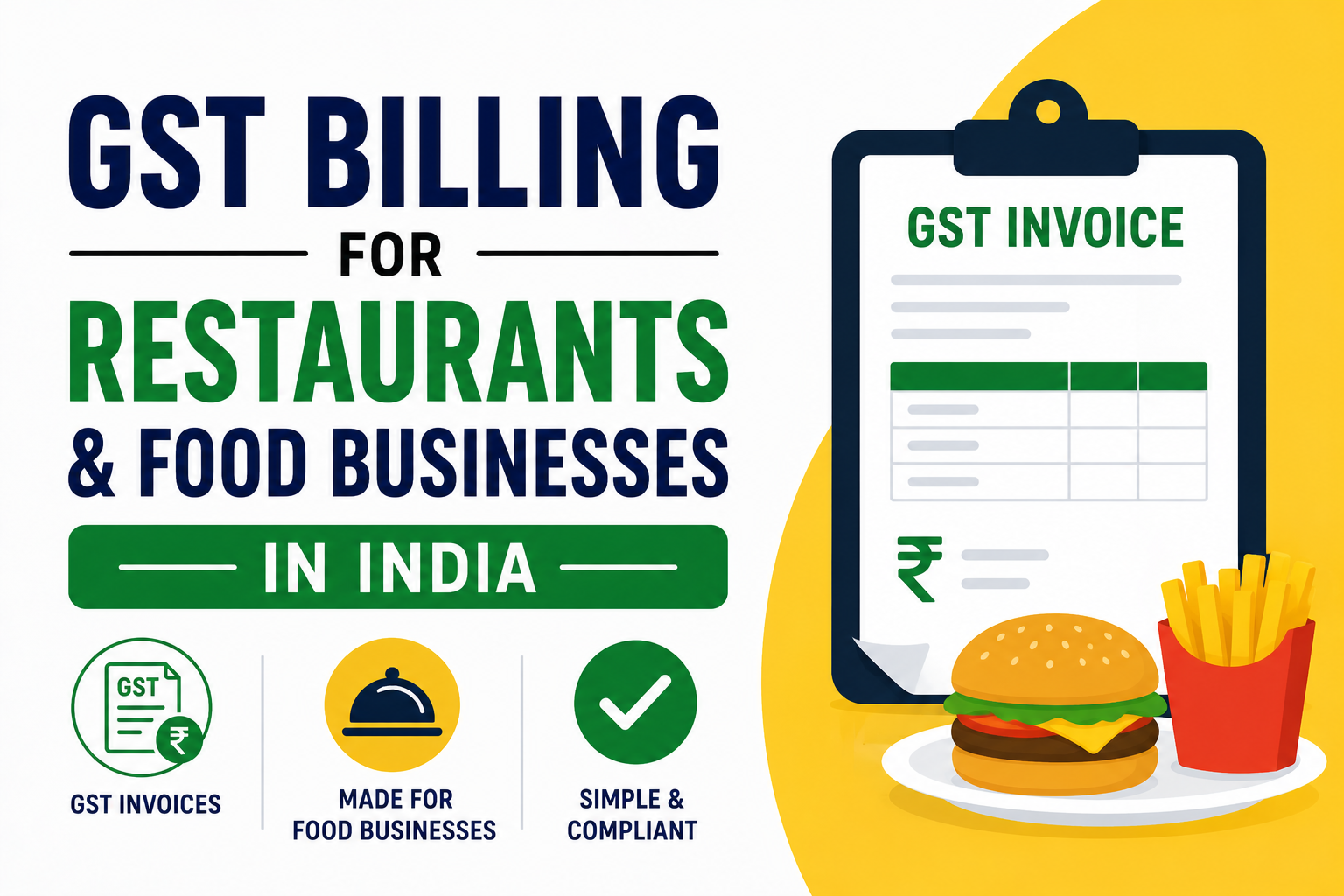
If you run a restaurant, cloud kitchen, food truck, bakery, catering business, or anything else in the food space in India, GST is one of those topics that looks simple on the surface and turns out to have several layers most people don't expect.
What rate applies to your restaurant? Does AC seating change anything? What about Swiggy and Zomato orders? How do you bill a catering event? What if you sell packaged food alongside restaurant meals?
Here's the full breakdown, and how GST Maker helps food businesses bill correctly and professionally.
What GST rate actually applies to you
Standalone restaurants (not inside a hotel) generally charge 5% GST, with no ITC — this applies whether you're AC or non-AC, ever since the government simplified the rules back in 2019 and dropped that distinction. The trade-off for the lower rate is that you can't claim input tax credit on your purchases.
Restaurants inside hotels depend on the room tariff — below ₹7,500 a night, the 5% no-ITC rate applies same as a standalone restaurant. At ₹7,500 or above, it jumps to 18%, but with ITC available on inputs.
Outdoor catering — food served at events, weddings, corporate functions, anywhere outside your own restaurant premises — sits at 18% with ITC. This is genuinely one of the most important distinctions for anyone running a catering business, since it's a completely different rate from serving the same food in-house.
Packaged and processed food varies by product — fresh unpackaged food (vegetables, fruits, unprocessed meat) is 0%, branded packaged food runs 5-18% depending on the item, bakery items similarly vary, and non-alcoholic beverages run 12-28% depending on type.
Cloud kitchens, despite having no dine-in space, are treated as restaurants for GST purposes and charge 5% with no ITC.
Food trucks follow the same restaurant rate — 5%, no ITC.
How Swiggy and Zomato orders actually work
This is one of the more commonly misunderstood parts of restaurant GST. Before October 2021, restaurants collected and deposited GST themselves on every order, including platform orders. Since then, for Swiggy and Zomato specifically, the platform itself collects and deposits the 5% GST directly — not you.
Practically, this means you don't collect GST from the customer on these orders, the platform handles that entirely, but you still need to report these sales in your GSTR-1 as outward supplies through an e-commerce operator, and you can't claim ITC on them regardless.
For direct orders — your own website, phone orders, walk-ins — nothing's changed. You charge 5% directly and deposit it yourself through GSTR-3B.
This split — platform orders reported separately from direct ones — needs genuinely organized record-keeping, and it's exactly where GST Maker helps by keeping your direct sales invoices clearly separate.
SAC codes for food businesses
| Type of Food Service | SAC Code | GST Rate |
|---|---|---|
| Restaurant services (dine-in, takeaway) | 996331 | 5% (No ITC) |
| Cloud kitchen / food delivery | 996331 | 5% (No ITC) |
| Food truck services | 996331 | 5% (No ITC) |
| Outdoor catering services | 996334 | 18% (With ITC) |
| Hotel restaurant (room tariff below ₹7,500) | 996331 | 5% (No ITC) |
| Hotel restaurant (room tariff ₹7,500+) | 996331 | 18% (With ITC) |
| Bakery (eat-in portion) | 996331 | 5% |
| Packaged bakery items sold separately | 1905 | 5%–18% |
| Canteen services in offices / factories | 996333 | 5% |
| Sweet shop (mithai, namkeen) | 2106 | 5%–12% |
AI Magic Fill suggests the right code as you type your service type.
How this actually works for a food business
Set up your restaurant or business profile once — name, GSTIN, address, logo — auto-filled forever after.
Most B2C restaurant sales — regular customers eating in or ordering food — don't need individual invoices at all. Where this actually matters is corporate bulk orders, catering contracts for weddings and events, canteen contracts, and packaged food distribution to retail stores. For all of these, GST Maker builds a proper GST-compliant invoice in under 60 seconds.
Save your catering service and restaurant service separately, each with its own SAC code and rate — 5% for one, 18% for the other — so the correct rate applies automatically depending on which one you select, never mixed up.
Share the link on WhatsApp the moment a booking's confirmed, which matters most for corporate clients and event organisers whose accounts teams need something clean to process.
If you're an outdoor caterer at 18%, the Expense Tracker captures raw material and equipment costs with GST paid, so ITC gets captured properly.
And every B2B and catering invoice organizes into a GSTR-1 ready report at month-end, so your CA isn't digging through WhatsApp orders and register tapes to reconstruct anything.
A catering business in Delhi
Ananya runs corporate lunches, wedding receptions, and office parties, all at client venues — meaning outdoor catering at 18%, generating ₹8-15 lakh a month.
Her invoices used to be typed in Word by an assistant, and applying 18% instead of the restaurant rate of 5% was a recurring point of confusion — she'd actually billed a few events at the wrong rate. Corporate clients with strict accounting processes often delayed payment simply because the invoice format wasn't what their team needed, and her CA spent hours reconstructing catering records for GSTR-1.
Now her catering service carries SAC 996334 at 18% automatically, her small dine-in section runs separately under SAC 996331 at 5%, corporate clients are saved with GSTIN and state, Delhi NCR gets CGST+SGST, out-of-Delhi events get IGST, and the invoice link goes out on WhatsApp within 2 minutes of any confirmed booking. Her CA's GSTR-1 filing now takes 45 minutes.
Corporate payment turnaround improved from 20-25 days down to 8-10 — mostly because the right invoice reached the right person in the right format immediately, not days after the event.
A cloud kitchen in Bengaluru
FreshBite operates purely across Swiggy and Zomato with no dine-in, plus direct WhatsApp orders from nearby office buildings, including three monthly corporate lunch contracts needing proper B2B invoices.
Platform orders already have GST handled by Swiggy and Zomato themselves. Direct WhatsApp orders now generate quickly under SAC 996331 at 5%, corporate lunch clients are saved with company GSTIN, monthly contracts run as recurring invoices auto-generated on the 1st, and IGST applies automatically for any out-of-Karnataka corporate billing address.
Their CA now reconciles Swiggy and Zomato TCS data against FreshBite's own direct sales cleanly every month, with no confusion between what the platforms handled and what was billed directly.
A bakery in Pune
SweetCrust runs both a café for dine-in customers and a wholesale distribution side selling packaged goods to supermarkets and gift shops — meaning café orders at 5%, packaged counter items at 5% or 12% depending on the product, and wholesale orders at 12% needing proper B2B invoices.
Now the café runs as a restaurant service at 5% under SAC 996331, each packaged product carries its own correct HSN code and rate, supermarket and gift shop clients are saved with GSTIN, and wholesale invoices calculate each item's tax separately with a clean combined total.
The owner no longer needs to call her CA monthly just to figure out which rate applies to which product — the saved product list handles that automatically now.
Questions food business owners actually ask
Do small dhabas and street stalls need to register? Only above ₹20 lakh for services or ₹40 lakh for goods — most small vendors sit comfortably below this and don't need registration.
Can a restaurant claim ITC on equipment or raw materials? Not under the 5% scheme — that's blocked entirely, and it's the trade-off for the lower rate. Outdoor caterers at 18% can claim ITC.
What about alcohol served in restaurants? Alcohol sits outside GST entirely, taxed instead under state excise. Food and non-alcoholic beverages alongside it still follow the applicable restaurant rate.
Does a restaurant need a GST invoice for every customer? For B2C walk-ins or delivery customers, a simplified consolidated invoice for the day is fine — a full tax invoice per order isn't required. For B2B corporate orders, a full tax invoice with buyer GSTIN is needed.
How's Swiggy/Zomato GST different from direct orders? Platforms collect and deposit GST on your behalf for their orders. Direct orders, you collect and deposit yourself. Both get reported in GSTR-1, just in different sections.
Questions people usually ask
What rate does a standalone restaurant charge? Most charge 5% with no ITC, AC or not.
What's the rate for catering? 18% with ITC, for anything served at an outside venue.
Does a cloud kitchen charge GST? Yes, 5% on direct orders, with platforms handling their own orders' GST separately.
Is this free for restaurants and food businesses? Yes — B2B invoices, catering invoices, recurring contracts, client management, expense tracking, and GSTR-1 reporting, all in the free plan.
Can I bill both restaurant and catering through this? Yes, saved separately with their own SAC codes and rates, applied automatically based on which one you pick.
Serve great food. Bill professionally. For free.
Running a food business is hard enough without billing adding to it. This gives restaurant owners, cloud kitchens, caterers, and bakeries a free system that handles the right GST rates, SAC codes, and GSTR-1 reporting automatically.
No credit card. No complicated setup. Your first food business invoice in 60 seconds.