AI Article Assistant
Ask questions, summarize, or extract key takeaways from this article.
GST Billing for E-Commerce Sellers in India — Amazon, Flipkart, Meesho and More
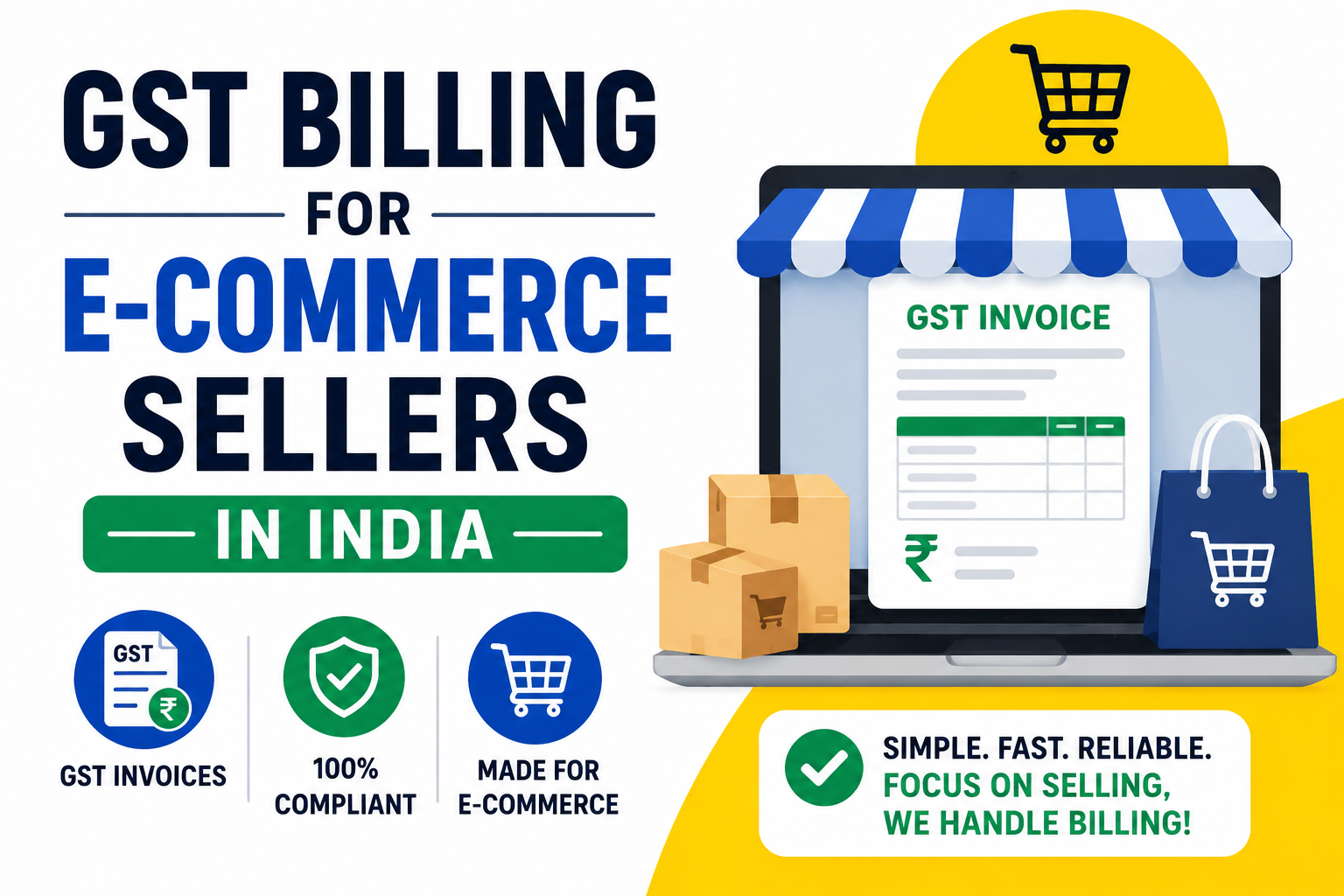
Selling on Amazon, Flipkart, Meesho, Myntra, or any other e-commerce platform in India is one of the fastest ways to reach real customers. Thousands of small sellers, artisans, home-based businesses, and manufacturers have built genuine businesses through these platforms.
But GST compliance for e-commerce sellers works differently — and more strictly — than for regular offline businesses. There are rules that apply specifically to marketplace sellers, and ignoring them can mean penalties, account suspension, or a tax notice.
Here's the full picture — mandatory registration, how TCS actually works, what invoices you genuinely need, and how GST Maker keeps the billing side organized.
The rule that catches almost everyone off guard
If you sell through Amazon, Flipkart, Meesho, or basically any marketplace, GST registration is mandatory regardless of your turnover.
The usual ₹40 lakh threshold for goods doesn't apply here. Sell even ₹1 lakh worth of product a year through most major platforms, and you still need a GSTIN.
This exists because platforms are required to collect Tax Collected at Source on your behalf, and TCS can only be deposited against a GSTIN. Sell without one, and you're non-compliant — the platform will eventually ask for your GST details or suspend your account outright.
What TCS actually is
TCS is a 1% GST deduction the platform takes from your sales before paying you out.
Sell something for ₹1,000 on Amazon, and Amazon collects the full ₹1,000 from the customer, deducts 1% TCS (₹10), and pays you ₹990 minus their commission and other charges. That ₹10 gets deposited with the government against your GSTIN.
When you file GSTR-3B, this shows up as a credit in your electronic cash ledger, reducing what you actually owe that month.
Worth understanding clearly — TCS isn't extra cost to you. It's an advance on your own GST liability, collected on your behalf, that you get back as credit when you file.
What invoices you actually need to issue
This confuses a lot of sellers. For B2C sales on the platform itself, Amazon or Flipkart generates the customer's invoice — you generally don't need a separate one for each order.
For B2B sales, where a business buyer needs a tax invoice from your own GSTIN rather than the platform's, you issue that yourself.
For anything off-platform — your own website, WhatsApp, direct sales — you need a proper tax invoice from your GSTIN, same as any regular business.
And for returns, a credit note against the original invoice is usually required.
This is really where GST Maker earns its place for an e-commerce seller — off-platform sales, B2B invoices, and any direct business you're running alongside your marketplace listings.
HSN codes — non-negotiable on e-commerce
Every product listed needs a correct HSN code, and platforms will ask for it at listing time. Get it wrong, and the wrong GST rate gets applied, which becomes a compliance headache later.
| Product Category | HSN Code | GST Rate |
|---|---|---|
| Mobile phones and accessories | 8517, 8504 | 18% |
| Laptops and computers | 8471 | 18% |
| Clothing and garments (below ₹1000) | 6105, 6205 | 5% |
| Clothing and garments (above ₹1000) | 6105, 6205 | 12% |
| Footwear (below ₹1000) | 6401–6405 | 5% |
| Footwear (above ₹1000) | 6401–6405 | 18% |
| Home décor and furnishings | 6304, 9405 | 12%–18% |
| Kitchenware and utensils | 7323, 3924 | 12%–18% |
| Books and printed material | 4901–4910 | 0%–12% |
| Toys and games | 9503 | 12% |
| Sports equipment | 9506 | 12%–18% |
| Beauty and personal care | 3304–3307 | 18%–28% |
| Health supplements | 2106 | 18% |
| Handmade and craft products | Varies | 5%–12% |
| Organic food products | 2106, 0904 | 5%–12% |
| Stationery items | 4820 | 12% |
| Bags and luggage | 4202 | 18% |
| Jewellery (fashion) | 7117 | 3% |
| Candles and home fragrance | 3406 | 12% |
AI Magic Fill suggests the right one as you type the product name.
How this actually helps an e-commerce seller
For direct and off-platform sales — your own website, Instagram, WhatsApp, in-person — GST Maker generates proper tax invoices with correct HSN codes, CGST/IGST, and sequential numbering.
For B2B buyers on a marketplace who specifically need a tax invoice from your own GSTIN, one's ready in under 60 seconds, shareable immediately over WhatsApp or email.
For wholesale buyers you supply directly — resellers, retailers, distributors — proper tax invoices with buyer GSTIN work exactly the same way.
The Expense Tracker captures GST paid on packaging, courier services, raw materials, and everything else, so your ITC stays properly captured monthly.
GSTR-1 reports organize your direct and B2B sales at month-end, which combined with the TCS data from your platform gives your CA everything needed to reconcile quickly.
And if you're managing stock across both marketplace and direct sales, inventory tracking updates automatically with every invoice you create.
A handmade jewellery seller in Jaipur
Kavita makes silver jewellery, selling through Amazon, her own Instagram shop, and directly at craft fairs. Amazon handles customer invoicing and TCS on its own, but her Instagram, direct, and boutique wholesale sales all need her own tax invoices.
She used to hand-write receipts for direct sales, and boutique buyers kept asking for "proper GST bills" she couldn't produce quickly — plus reconciling Amazon's TCS against her own records at month-end was a genuine headache.
Now her Instagram and direct sales get invoiced in 60 seconds under HSN 7117 at 3%, boutique buyers are saved with their GSTIN for instant B2B invoices, IGST applies automatically for out-of-Rajasthan boutiques, and her monthly GSTR-1 report includes all direct sales, ready for her CA to reconcile against the Amazon TCS data.
Her boutique clients — previously hesitant because her billing looked unprofessional — now place consistent wholesale orders, and her direct revenue has grown simply because every customer can actually be billed properly now.
A home decor seller on Flipkart and Meesho
Rohit sells handmade wall hangings, cushion covers, and pottery from Rajasthan on both platforms, which each deduct TCS separately, while also selling directly to interior designers who need B2B invoices — all across products with different GST rates.
Now all his products carry correct HSN codes and rates, interior designer clients are saved with their GSTIN, B2B invoices apply the right IGST for out-of-state designers, and his expense tracker captures raw material purchases for ITC. His monthly report hands his CA clean direct-sales data to combine with the platforms' TCS statements.
His CA now finishes filing in one sitting instead of spending two days gathering scattered records first.
A clothing reseller on Meesho
Priya resells women's clothing on Meesho from Indore, sourcing from wholesale markets. She didn't realize registration was mandatory for Meesho sellers when she started, and her account got flagged six months in, forcing a rushed registration.
After setting up properly — profile with GSTIN in 5 minutes, products added with correct garment HSN codes — Meesho still handles its own customer invoicing, but GST Maker covers her growing WhatsApp customer base for direct sales, each getting a proper invoice link. Monthly expense tracking covers packaging and courier costs for correct ITC.
Her WhatsApp direct sales, which started as a side channel almost by accident, now make up 30% of her total revenue — all properly invoiced.
Filing returns as an e-commerce seller
You file the same GSTR-1 and GSTR-3B as any other registered business, monthly or quarterly.
GSTR-1 covers your outward supplies — use GST Maker's ready report for direct and B2B sales, and report the net figure for platform sales where the platform's already handling customer invoicing.
GSTR-3B is where you pay net liability — TCS collected by Amazon or Flipkart shows up as a credit in your cash ledger, reducing what you owe.
GSTR-8 is actually filed by the platform itself, not you — it reports the TCS collected across all sellers, and your job is just verifying the number matches your own records.
Reconciliation means matching your sales records against what the platform reports in GSTR-8, and chasing down anything that doesn't line up before filing.
GST Maker's GSTR-1 ready report gives you clean data on the direct-sales side, which makes the overall reconciliation with your CA considerably faster.
Questions people usually ask
Is GST registration mandatory for all e-commerce sellers? Yes, regardless of turnover — the usual ₹40 lakh threshold doesn't apply to marketplace sellers.
What is TCS and how does it affect me? A 1% deduction the platform takes before paying you, deposited against your GSTIN, showing up as a credit when you file GSTR-3B — not an extra cost.
Do I need separate invoices for Amazon or Flipkart sales? Not for B2C sales on the platform itself — but yes for direct sales, B2B buyers needing your GSTIN, and wholesale orders outside the platform.
Can I use GST Maker for e-commerce billing? Yes, ideal for direct sales, B2B invoices, wholesale orders, expense tracking, and GSTR-1 prep — it complements whatever the platform already handles.
What HSN code should I use? Depends on your product category — AI Magic Fill suggests the right one as you type. Common ones: garments 6205, mobile accessories 8517, home decor 9405, toys 9503.
Is this free for e-commerce sellers? Yes — tax invoices, expense tracking, inventory management, client management, and GSTR-1 reporting, all in the free plan.
Sell more. Bill smarter. Stay compliant, for free.
E-commerce is one of the biggest opportunities for small sellers in India right now, but GST compliance isn't optional, and staying on top of it while running the actual store is genuinely a lot to juggle.
This gives e-commerce sellers a free billing system for everything the platform doesn't already cover — direct sales, B2B invoices, correct HSN codes, automatic CGST/IGST, and GSTR-1 ready reports.
No credit card. No complicated setup. Your first e-commerce invoice in 60 seconds.