AI Article Assistant
Ask questions, summarize, or extract key takeaways from this article.
You Drive for Ola or Deliver for Swiggy. Here's What the Tax Department Expects From You.
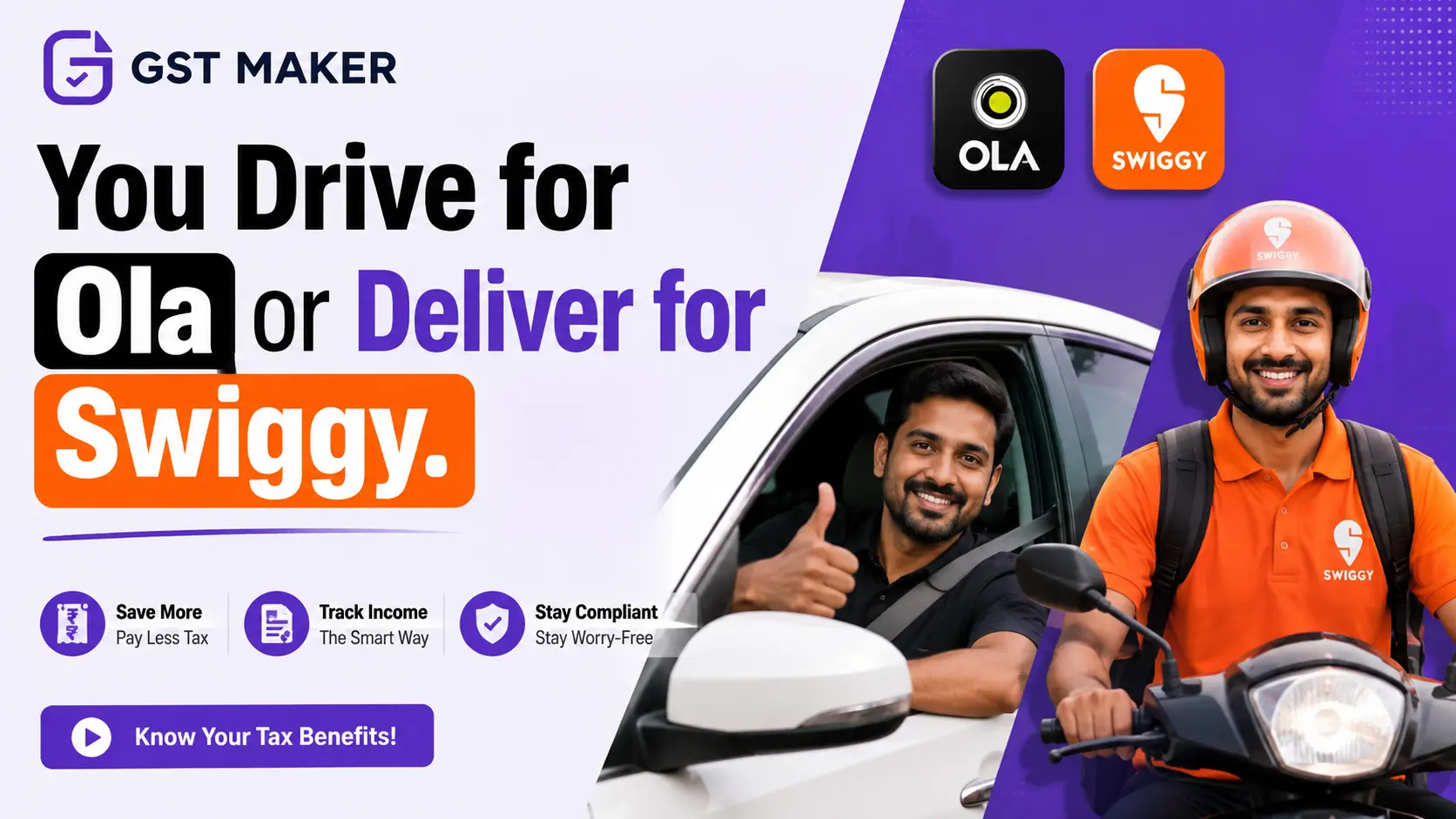
There are more than 1.5 crore gig workers in India right now.
Delivery partners. Driver partners. Freelance taskers on Urban Company. Home chefs on platforms. Hyperlocal service providers. The people who bring your food, fix your AC, clean your house, and drive you home.
Most of them have no idea what their tax obligations are. Not because they are trying to evade anything — but because nobody has ever explained it to them clearly. The platforms they work with provide earnings statements but not tax guidance. Most accountants are not set up to serve clients earning ₹15,000–30,000 a month informally. And the government's communication on this has been scattered and technical.
So let me just explain it directly.
Are You an Employee or a Contractor? It Matters More Than You Think.
Every gig worker in India is treated as an independent contractor — not an employee — for tax purposes.
This is not a technicality. It changes everything about how you are taxed.
An Ola driver does not get a salary. They get earnings from trips, minus Ola's commission. No TDS is deducted from that the way it would be from a salary. No Form 16 is issued. No EPF contributions are made by Ola on their behalf.
The same is true for a Swiggy delivery partner, an Urban Company professional, a Dunzo runner, or anyone else working through a platform as a partner rather than as an employee.
What this means: your income from gig work is business income — taxed under the head "Profits and Gains of Business or Profession." And you are responsible for figuring out what you owe and paying it yourself.
The platforms are not your employer. They are your clients.
Income Tax — The Basic Rules
Everyone in India whose total annual income exceeds ₹4 lakh is liable to pay income tax under the new regime. Below ₹4 lakh, there is no liability. And because of the Section 87A rebate, anyone with annual income up to ₹12 lakh effectively pays zero tax under the new tax regime.
For most gig workers earning ₹2–4 lakh a year — part-time delivery partners, weekend Ola drivers, occasional Urban Company jobs — the income tax question is simple: you likely owe nothing, but you should still file if any TDS has been deducted from your earnings.
For higher earners — a full-time Swiggy partner doing 30+ deliveries a day, or an Urban Company professional with a full client load — annual earnings can reach ₹5–10 lakh. At that level, income tax becomes real and needs to be managed.
The good news for gig workers: under Section 44ADA of the old Income Tax Act — now renumbered Section 58 in the Income Tax Act 2025 — you can declare 50% of gross receipts as income under presumptive taxation, as long as your total receipts are under ₹50 lakh. No itemised expense tracking. No detailed books. Just 50% of what you earned.
A delivery partner who earns ₹8 lakh from Swiggy in a year declares ₹4 lakh as taxable income. Under the new regime with the standard deduction of ₹75,000, taxable income is ₹3.25 lakh. Zero tax owed. But they should still file an ITR to claim back any TDS that was deducted.
TDS — The Money That Was Already Taken
Here is something many gig workers discover only at tax time — and it creates a lot of confusion.
Platforms that pay professional fees to partners deduct TDS (Tax Deducted at Source) before transferring earnings. Under Section 194C, payments to contractors attract 1% TDS for individuals. Under Section 194J, professional services attract 10% TDS.
Not every platform deducts TDS for every payment. Some do it only above certain thresholds. Some do it only for certain categories of partners. But if you have been earning through a platform for a full year, there is a reasonable chance some amount of TDS has been deducted from your total earnings.
This money has already gone to the Income Tax Department against your PAN. When you file your ITR, you declare your income and tax liability. If your liability is less than the TDS that was deducted — which is common for gig workers at lower income levels — you get a refund.
The refund does not come automatically. You have to file the return to claim it.
Over 2 crore Indians have TDS deducted from earnings that they have never filed returns for. The money sits with the government as unclaimed credit. For gig workers — many of whom would owe no tax at all given their income levels — this is money they are entitled to but have not collected.
File the return. Claim the refund.
GST — When Does It Apply to You?
This is the question that creates the most confusion in the gig economy, and a significant policy shift happened in September 2025 that changes the answer for many workers.
The basic rule: if your total earnings from gig work exceed ₹20 lakh in a financial year, GST registration becomes mandatory and you must charge 18% GST on your services.
For most part-time gig workers, this threshold is not a concern. The average Swiggy delivery partner earns ₹15,000–25,000 per month — well under the annual threshold.
For full-time professionals on Urban Company — electricians, plumbers, beauticians, and other skilled service providers who build a loyal client base — annual earnings can exceed ₹20 lakh. At that point, GST registration and quarterly filing become necessary.
But here is the significant development from September 2025.
The September 2025 GST Council Ruling — And Why It Matters for Delivery Workers
At the 56th GST Council meeting in September 2025, the Council clarified that platforms like Swiggy and Zomato are responsible for paying 18% GST on delivery charges collected from users — even when those deliveries are carried out by gig workers.
This reversed a long-standing ambiguity. Previously, the argument was that delivery charges flowed through the platform to the gig worker, who was the actual service provider. The platforms argued they were just facilitating the transaction. The government disagreed.
The Council confirmed that since the platforms collect the delivery fee from the consumer, they are the deemed supplier and bear the GST liability under Section 9(5) of the CGST Act. The same framework that already applied to Ola and Uber for passenger transport, and to restaurant services on Zomato and Swiggy, now explicitly covers delivery services too.
The immediate financial impact: Zomato and Swiggy together face an estimated ₹400 crore in annual additional GST liability. Both companies are evaluating how to manage this cost — some of it may eventually be passed to consumers through higher delivery fees, and there are concerns in the industry that delivery partner payouts may also be affected to manage margins.
For the delivery worker on the ground, the direct GST implication of this ruling is limited — the liability sits with the platform, not the individual partner. But the indirect effect on partner earnings is worth watching.
Urban Company, Dunzo, and Skilled Service Platforms — Different Rules
For service professionals on Urban Company — electricians, plumbers, carpenters, beauty professionals, yoga instructors, and others — the tax picture is different from delivery workers.
Urban Company charges customers and pays the professional a share. Whether this is structured as a platform fee (Urban Company earns a commission and the professional receives the rest) or as an aggregated payment has implications for who bears GST liability.
Under the current framework, Urban Company — as an e-commerce operator in the housekeeping and professional services category — is covered under Section 9(5) for certain services. The platform pays GST on the service amount; the individual professional below the ₹20 lakh threshold is not required to register separately.
However, if a skilled professional on Urban Company builds a practice earning above ₹20 lakh — which is achievable for experienced professionals in metro cities — individual GST registration becomes mandatory for any services they provide outside the platform or directly to clients.
The practical situation for most Urban Company professionals earning ₹10–18 lakh a year: income tax under presumptive taxation (declare 50% as income, file ITR-4), no GST required, and a refund to claim if TDS has been deducted.
The Social Security Change — New From November 2025
There is another development from 2025 that gig workers should know about, even though it is not directly a tax matter.
From November 21, 2025, India's new labour codes came into effect for the gig economy. Under these codes, platform companies like Swiggy, Zomato, Ola, and Uber are required to contribute 1–2% of their annual turnover — capped at 5% of total payments made to gig workers — to a social security fund for those workers.
This covers health benefits, accident insurance, and eventually retirement savings for gig workers registered under the scheme. It does not change income tax obligations. But it does mean that platforms are now required to maintain formal records of gig worker earnings and contributions in a way that feeds directly into the government's data systems.
For workers who have been informal about their income documentation — not keeping payment statements, not cross-checking with AIS — the formalisation of gig worker data through the social security system means the government will increasingly have this information regardless.
The Multi-Platform Problem — Ulti-Homing and Taxes
Many gig workers work across multiple platforms simultaneously. A driver might be on Ola and InDrive. A delivery partner might toggle between Swiggy and Zomato. A service professional might take jobs from Urban Company and also work directly with regular clients.
For income tax, this is fine — you add up all earnings from all sources and declare total income. But it creates a documentation challenge.
Each platform provides its own earnings statement. If you are on three platforms, you have three statements that need to be added up. Any TDS deducted by any platform appears in your AIS under your PAN — which means the Income Tax Department can see all of it. If your ITR does not account for all three income streams, the mismatch between your AIS and your return triggers an automated notice.
Download your AIS before you file. Make sure the total income you declare is at least equal to what AIS shows. Any income that appears in AIS but not in your return is the exact kind of discrepancy the CBDT's AI systems flag immediately.
What You Actually Need to Do
For a gig worker at any earning level, the practical steps are:
If you earn under ₹4 lakh a year from gig work: You owe no income tax. But download your AIS from the income tax portal and check whether any TDS was deducted. If it was, file ITR-4 to claim the refund. It takes about 20–30 minutes if you use an online filing service.
If you earn ₹4–12 lakh a year: You likely owe little or no income tax under the new regime's zero-tax threshold. File ITR-4 using the presumptive scheme. Declare 50% of gross receipts as income. Claim TDS credit. Pay any balance due or receive a refund.
If you earn above ₹12 lakh a year: Income tax becomes real. The marginal rates above ₹12 lakh are 15%, 20%, 25%, and 30%. Pay advance tax by March 15th if your expected liability exceeds ₹10,000 for the year. File ITR-3 or ITR-4 depending on whether you are using presumptive taxation.
If you earn above ₹20 lakh a year: GST registration is mandatory. You will need to charge 18% GST on your services (for direct client work not covered by platform GST liability), file GSTR-1 and GSTR-3B monthly or quarterly, and maintain proper invoice records.
One Thing Worth Saying Clearly
The Indian tax system was not designed with gig workers in mind. The presumptive taxation scheme helps — it removes the need for detailed bookkeeping. The zero-tax threshold up to ₹12 lakh helps. The TDS refund system, when it works, returns money that was never owed.
But the compliance infrastructure — filing portals, form selection, AIS interpretation — still assumes a level of financial literacy that many gig workers have not had reason to develop.
If you are a gig worker and you are unsure whether you need to file, whether TDS was deducted, or what your liability is: the AIS on the income tax portal tells you what the government knows about your income. Start there. If the numbers are confusing, a tax filing service or a CA who works with gig workers can file your return for a few hundred rupees.
The refund you might collect will almost certainly be more than you pay them.
For gig workers who build a practice that reaches the GST threshold — skilled professionals, high-earning delivery partners, those who expand beyond a single platform — proper invoicing becomes necessary.
👉 GST Maker handles the invoicing side — free at gstmaker.com
Professional invoices, correct GST calculation, GSTR-1 ready reports. For when your gig becomes a real business.