AI Article Assistant
Ask questions, summarize, or extract key takeaways from this article.
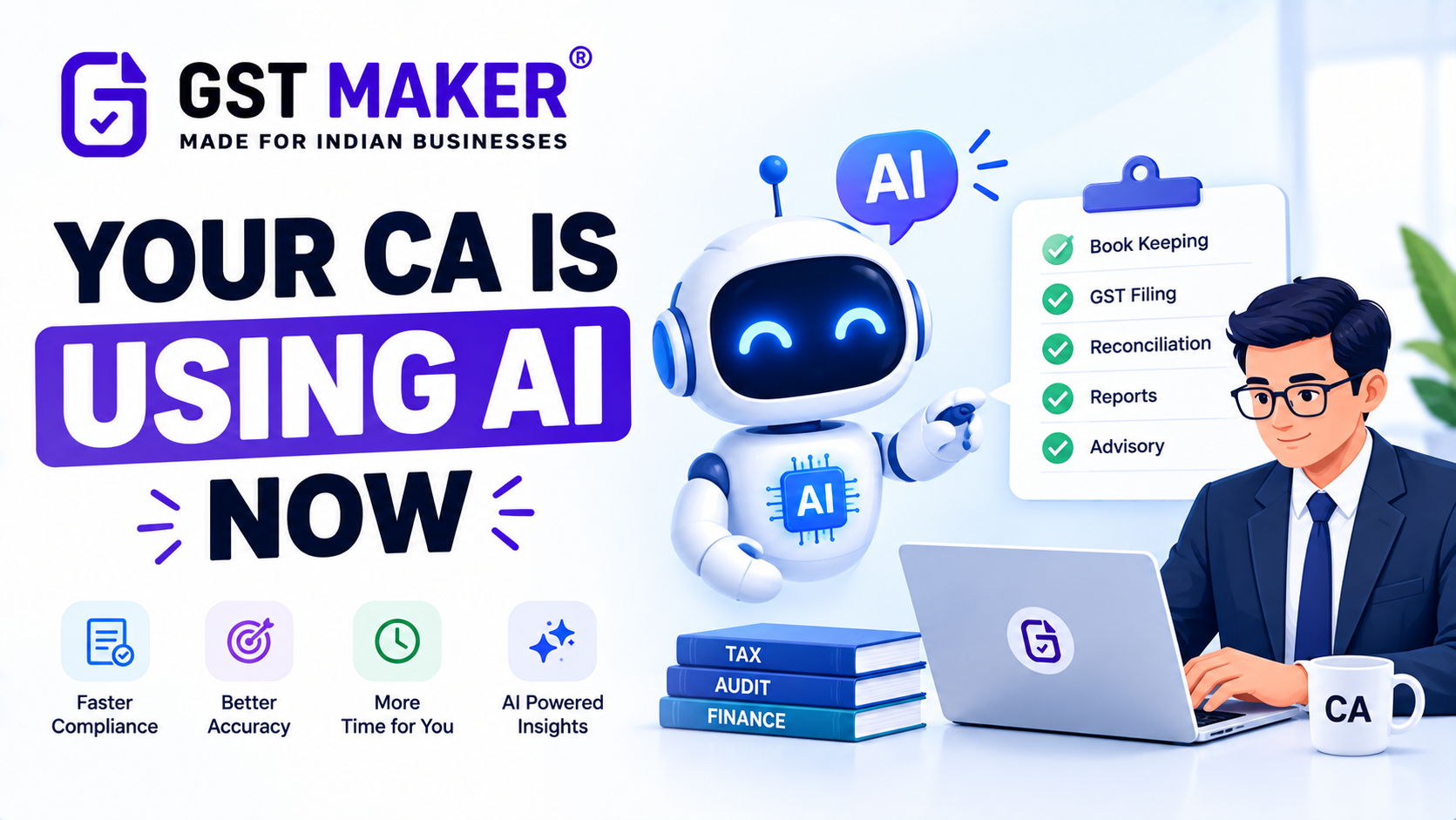
Your CA Is Using AI Now. Here Is What That Means for You as a Small Business Owner.
At the AI Innovation Summit in Pune in 2025, the President of ICAI — the body that governs every Chartered Accountant in India — said something that was remarkable for how direct it was.
"AI is not just a tool. It is a professional imperative."
The Vice President followed up with something even more pointed: "There is no alternative to adapting to AI. Lakhs of CAs and students are already using these tools."
This was not a tech conference. This was the professional body of Indian accountancy telling its 300,000+ members that the way they work is changing and they need to get on board.
That shift has implications for the small business owners and freelancers who use those CAs — implications that are worth understanding even if you never think about accounting software yourself.
What Is Actually Changing in How CAs Work
The most honest way to describe what AI is doing to CA work in India is this: it is compressing the time required for mechanical tasks dramatically, while leaving judgment, representation, and advisory work entirely in human hands.
The mechanical tasks in a typical CA's day are significant. Reconciling GSTR-2A and GSTR-2B against purchase invoices. Matching invoice data across different software systems. Extracting information from stacks of bills and receipts. Preparing first drafts of ITR schedules. Checking for mismatches between what a client filed and what their counterparties filed.
These are not simple tasks. They require accounting knowledge. But they are rule-based, repetitive, and high-volume — exactly the conditions where AI performs well.
The realistic estimate from practitioners who have implemented these tools: 5 to 10 hours saved per client per compliance cycle. For a CA managing 50 clients, that is 250 to 500 hours per quarter that previously went to data matching and now can go elsewhere.
Where does it go? Either into more clients — the same CA can now handle a larger client base — or into deeper advisory work for existing clients — the kind of tax planning and business advice that commands higher fees and creates more value.
The Tools That Are Actually Being Used
It is worth being specific here because the AI tools CA community uses are not the generic chatbots most people think of.
VIDUR AI is specifically built for Indian CA compliance work — GST queries, ITR guidance, regulatory updates. It is trained on Indian tax law specifically, not general knowledge.
Provi AI connects directly to Tally and Zoho Books and handles GST filing, GSTR-2A reconciliation, TDS tracking, and ITR preparation using real client data from the accounting software. Not a generic system — one that plugs into the tools CAs already use.
ICAI itself launched an AI portal with tools including EasyRecon for offline GST reconciliation and a SMART AI ITR Assistant for document analysis. When the professional body of Indian accountancy is building and hosting its own AI tools, it is not a niche experiment anymore.
ClearTax, which many CAs already use for compliance, has built AI into its reconciliation and mismatch detection workflows — flagging potential issues before the return is filed rather than waiting for a government notice to identify them.
The pattern across all of these: purpose-built for Indian compliance, connected to real accounting data, focused on the high-volume mechanical work.
What AI Cannot Do — And This Part Matters
There is a version of this story that makes small business owners nervous. Automation arrives, CAs become cheaper or irrelevant, compliance becomes a self-service commodity.
That is not what is happening. And it is worth being clear about why.
AI can process data. It cannot exercise judgment. When a GST notice arrives with unusual language that suggests the officer is fishing for something specific, a CA who has dealt with that officer's jurisdiction before has context that no AI system has. When a client's business structure is unusual — a freelancer who holds equity in one startup client, a partnership that is converting to a private limited — the tax implications require judgment, not pattern matching.
AI can flag what looks like an anomaly. It cannot know whether the anomaly is a genuine error or a legitimate business circumstance. A CA still has to make that call.
AI can draft a response to a notice. A CA has to sign off on it, take professional responsibility for it, and sometimes appear before an officer to discuss it.
The 64% of accountants who now use AI for communication tasks — drafting client emails, summarising documents — are using it as a writing assistant, not as a decision-maker. The decision is still theirs.
What is changing is the ratio of mechanical time to judgment time in a CA's working day. AI is shifting that ratio — the mechanical work is getting compressed, and the judgment work remains.
What This Means for What You Pay Your CA
This is the practical question most small business owners actually want answered.
If a CA using AI can handle reconciliation in 2 hours that used to take a full day, are fees going to come down?
Honestly — it depends on the CA and on what you are paying for.
For purely mechanical services — data entry, basic return preparation, routine reconciliation — there is downward pressure on fees as AI makes those tasks faster. Some CAs are already charging less for volume work because the cost per client has dropped.
For advisory services — tax planning, responding to notices, structuring a business transaction, navigating a complex compliance situation — fees are unlikely to drop and may increase. Because the AI tools that handle the mechanical work create bandwidth for CAs to do more high-value work, and the market for that work is competitive.
What you should be asking your CA — or any CA you are evaluating — is not whether they use AI but which tasks it is applied to and what that frees them up to do for you.
A CA who uses AI for reconciliation but still charges you the same fee as before and does not do more advisory work for that fee is capturing all the efficiency gain themselves. That is not necessarily wrong — they have invested in tools and training. But it is worth understanding.
The Data Quality Problem — Why This Affects You Directly
Here is where this stops being abstract and becomes your problem.
AI reconciliation tools work on clean data. They match invoice records, compare filing data, and flag mismatches — but only if the underlying data is structured and consistent.
When your own invoice records are a mess — scattered across different formats, missing fields, inconsistent GSTIN entries — the AI tools your CA is trying to use on your behalf either produce unreliable output or require your CA to spend significant manual time cleaning the data before the AI can run on it.
That manual cleaning time is still billed to you. It just is not visible as a line item.
The practical implication: the cleaner your invoice data, the more effectively your CA's AI tools can work on it, and the less time they spend on manual data cleaning that you ultimately pay for.
A client who comes to their CA with 12 months of organised, correctly structured invoice data in a GSTR-1 ready format spends significantly less in CA fees than one who provides a folder of PDF invoices in varying formats with inconsistent numbering and occasional wrong GSTINs.
This is not a new insight. But the introduction of AI into CA workflows has made the data quality gap more expensive than it used to be, not less.
The Vendor Side — What Your Suppliers Need to Do
There is a second-order effect that is worth mentioning.
Because AI reconciliation tools are doing GSTR-2B matching at scale, mismatches are being caught faster than before. CAs are now identifying — often automatically — which of their client's suppliers have not filed their returns, or have filed with wrong invoice details.
Before AI-assisted reconciliation became common, these mismatches might take months to surface, sometimes only at annual return time. Now they are caught monthly, sometimes weekly.
What this means for you: if you are a supplier to businesses that use these tools, your filing accuracy matters more than it did two years ago. A client whose CA is running AI reconciliation on their GSTR-2B will notice immediately if your invoices are not showing up or are showing up with wrong details. You will get a call.
And if you are a buyer whose suppliers are not filing on time, your CA's tools will now surface those gaps immediately — which flows into the ITC hard block and affects your own GSTR-3B.
The compliance chain is tighter than it has ever been.
The Honest Summary
AI is genuinely changing how Indian CAs work. Not by replacing them — the judgment, representation, and advisory functions that make a good CA valuable are not going anywhere. But by compressing the mechanical, high-volume parts of compliance work significantly.
For small business owners, the implications are practical:
Clean data matters more now. Your CA's AI tools work on your records. The cleaner they are, the better the tools perform, and the less manual cleanup you pay for.
The mechanical cost of compliance is going down over time. Return preparation, basic reconciliation, data matching — these are getting cheaper as AI handles more of the volume. The advisory cost is not going down.
Your supplier's compliance affects you faster than before. AI-assisted reconciliation surfaces mismatches immediately, not months later.
And for anyone thinking about switching CAs or engaging one for the first time — asking what tools they use and how they are using AI to improve the quality and speed of their work is a legitimate question. The profession's leadership has already said it is a professional imperative. It is reasonable to expect your CA to have an answer.
The client side of all this — clean invoice records, correct GSTIN data, organised GSTR-1 exports — is what GST Maker handles.
When your CA's AI tools run on your data, give them something clean to work with.