AI Article Assistant
Ask questions, summarize, or extract key takeaways from this article.
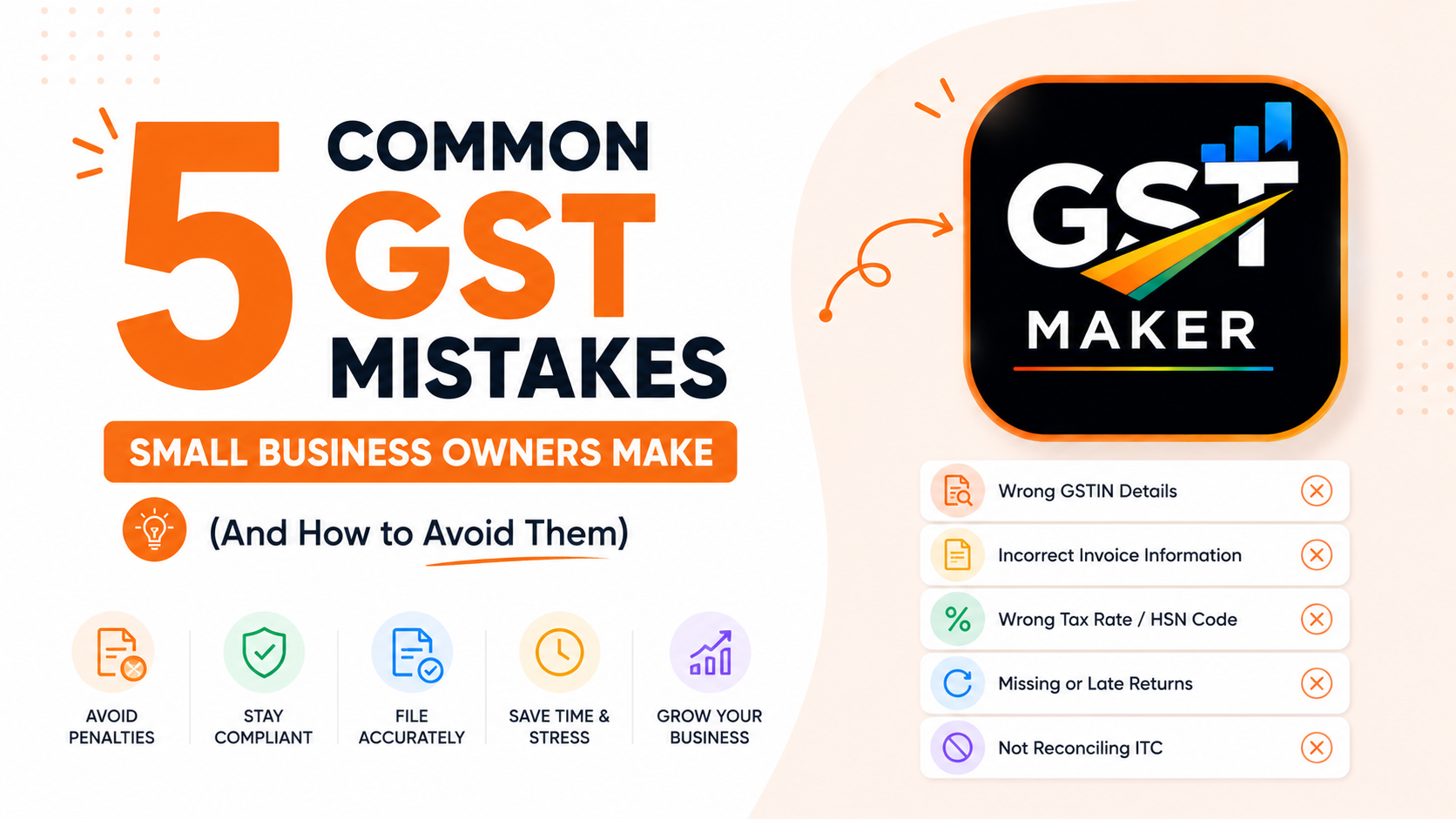
5 Common GST Mistakes Small Business Owners Make (And How to Avoid Them)
Running a small business in India means wearing a lot of hats. Managing customers, handling inventory, actually delivering the work — and somewhere in between all of that, staying on top of GST compliance.
Here's the thing though — most small business owners aren't accountants. They're plumbers, consultants, shop owners, freelancers, traders. GST is just one more item on an already long list.
That's exactly why mistakes happen. Not because anyone's careless — but because GST comes with a bunch of small rules that are genuinely easy to miss if nobody ever explained them properly.
So let's go through 5 of the most common GST mistakes small businesses make, and how to avoid them before they turn into a notice or a penalty.
Mistake 1: Mixing up CGST/SGST with IGST
Probably the most common one out there. A lot of business owners just charge CGST and SGST on every single invoice, without actually checking whether the customer is in the same state or a different one.
The rule is simple:
- Same state as you? CGST + SGST.
- Different state? IGST.
So if you're in Delhi selling to someone in Delhi, split the GST into CGST and SGST. Sell to someone in Mumbai instead, and it's IGST, full stop.
Get this wrong, and your customer can't properly claim their input tax credit. That creates friction with clients, and it can mess with your own return filing too.
Fix: Use a billing tool that checks the customer's state automatically — like GST Maker does — so you never have to think about it. It just applies the right type.
Mistake 2: Missing or wrong HSN/SAC code
Every product needs an HSN code, every service needs a SAC code, and these are mandatory on a GST invoice. Skip it, or put the wrong one, and technically your invoice isn't valid.
I've seen business owners either leave this field blank or just copy some random code they found online. Both come back to haunt you during an audit.
Fix: Actually look up the right HSN or SAC code before you start billing. GST Maker has a built-in search for this, and once you save a product, the code auto-fills every time going forward. Do it once, never think about it again.
Mistake 3: Sending invoices late
GST rules put actual deadlines on this. For goods, the invoice should go out at or before the time of supply. For services, you've got 30 days from when the work's done.
But a lot of freelancers and consultants send invoices weeks after finishing a job. That's not just bad for cash flow — the invoice date decides which month's return it falls under, so a late invoice can throw off your filing too.
Fix: Raise the invoice the same day you deliver the work. With something like GST Maker, generating and sending an invoice from your phone takes under a minute — there's really no reason to put it off.
Mistake 4: No real record-keeping
Some people are still creating invoices as WhatsApp photos of handwritten bills. Others use Word or Excel with no proper numbering at all. Then tax season arrives, and finding a specific invoice turns into an actual hunt.
GST requires proper records — every invoice needs a unique, sequential number, and you should be able to pull up your history fast if you're filing returns or facing an audit.
Fix: Get on a real invoicing system from day one. GST Maker keeps everything together — proper numbering, dates, customer details — and you can search, filter, and export anytime. No more digging through old chats or a folder full of scattered Excel files.
Mistake 5: Charging GST when you shouldn't (or not charging when you should)
This one catches people off guard. Not every business is required to charge GST.
Under ₹20 lakh in annual turnover (₹10 lakh for a few special category states) and you don't need to register at all. If you're not registered, you shouldn't be charging GST on invoices — doing that anyway is actually illegal.
But cross ₹20 lakh, and registration becomes mandatory. A lot of small businesses cross this line without realizing it, and that's exactly how penalties happen later.
Fix: Know your registration status. Not registered — issue a plain invoice, no GST. Registered — always include it. And if you're getting close to ₹20 lakh, register before you cross it, not after.
Bonus mistake: forgetting GSTR-1 and GSTR-3B deadlines
Not strictly an invoicing mistake, but it's tied to everything above. Plenty of business owners create their invoices fine, then just forget to file returns on time — and late filing means late fees plus interest, for no good reason.
GSTR-1 covers your outward sales. GSTR-3B is where you actually pay the tax. Both come with monthly or quarterly deadlines depending on your category.
Fix: Set actual reminders for these dates. And use something that exports your invoice data in the right format — GST Maker generates GSTR-1 ready reports you can use directly while filing, which saves time and cuts down on errors.
The bigger picture
None of these mistakes happen on purpose. GST just has a lot of moving parts, and small business owners are busy actually running their businesses — not reading up on tax rules in their spare time.
The good part is that the right tool removes most of this automatically. When your billing software handles the GST type, the HSN codes, the invoice numbering, and the reports for you, there's not much left for you to get wrong.
That's the whole point of GST Maker — keep it simple, keep it correct, and keep your business out of trouble.
If you're still doing this manually, it's a good time to switch. Head to gstmaker.com and try it for free — your first invoice will show you exactly how much easier this can be.