AI Article Assistant
Ask questions, summarize, or extract key takeaways from this article.
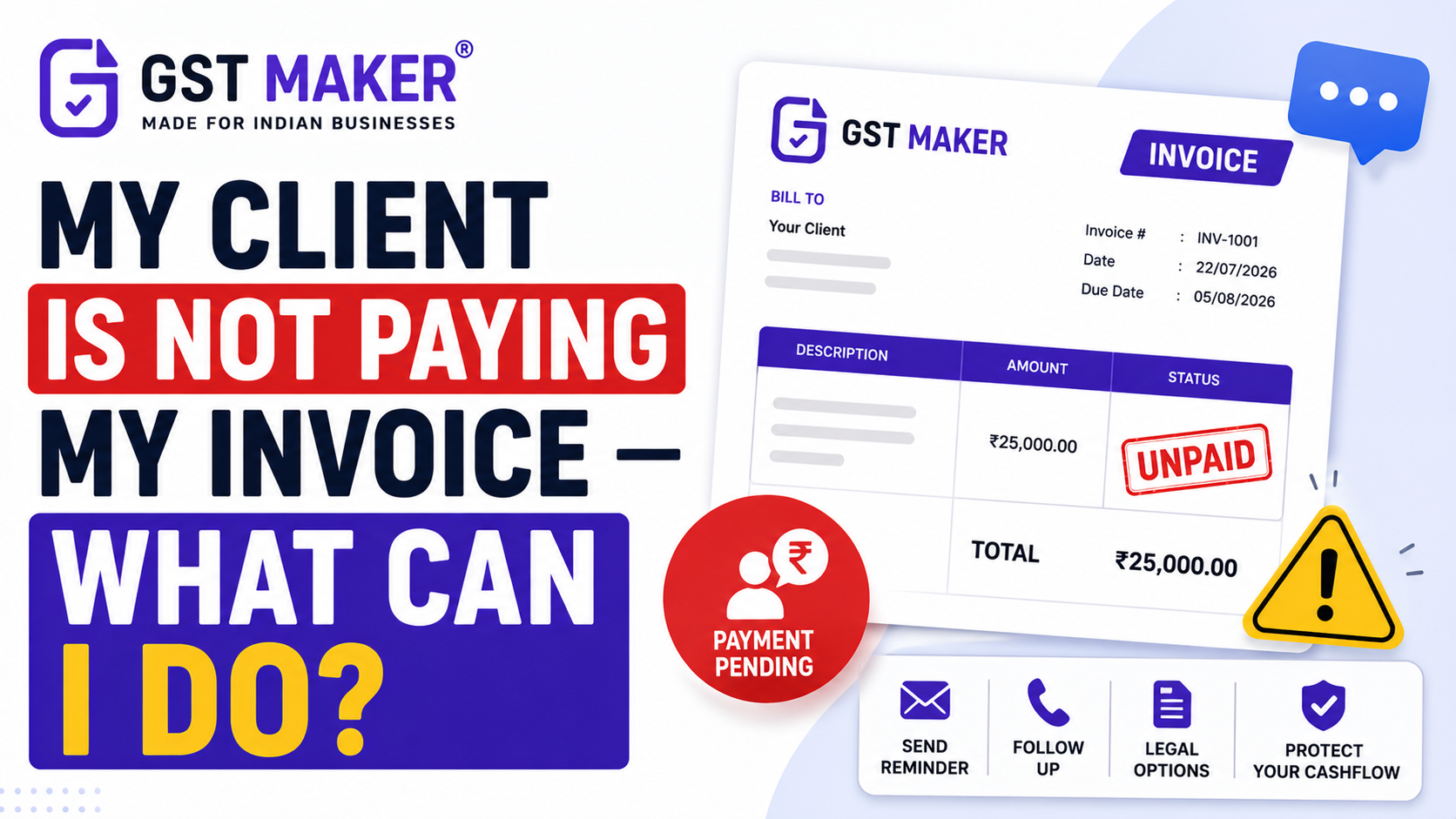
My Client is Not Paying My Invoice — What Can I Do?
It is 11 PM.
You are staring at an invoice that is 47 days overdue. You have sent three WhatsApp reminders. All delivered. Blue ticks. No reply. You did the work. You revised it twice. You were professional throughout.
And now you are the one losing sleep over their money.
This is one of the most common problems freelancers and small business owners face in India. And yet nobody really prepares you for it. So let me tell you what your actual options are — from the first reminder to the last legal resort.
Before Anything Else — Check These Four Things
Before you escalate anything, make sure your side of the documentation is clean.
Do you have a proper invoice? Not a WhatsApp message with a bank account number. A proper invoice with your business name, GSTIN if registered, invoice number, date, service description, amount, and payment terms. If your invoice is vague or informal, a client can claim confusion about what they were supposed to pay and when.
Did you send the invoice to the right person? The person who approved your project is often not the person who processes payments. In companies, invoices need to reach the accounts department — sometimes through a specific email or a procurement portal. Many delayed payments are simply the invoice sitting in the wrong inbox.
What are your payment terms? If you never specified a due date — "payment due within 15 days" — then technically the client has not missed a deadline. For future invoices, always mention payment terms clearly. Net 15 or Net 30 from invoice date.
Do you have proof of delivery? An email acknowledging receipt of your work. A WhatsApp message saying "looks good." A signed acceptance form. Without some proof that you delivered what was agreed, collection becomes much harder. Even a "thanks, received" from the client on WhatsApp counts as evidence.
Get these in order before you escalate. They are your ammunition.
Step 1 — The Structured Reminder (Days 1–15 Overdue)
Most overdue invoices are not malicious. They are forgotten. The client is busy, their accounts team missed it, or the invoice is sitting in a spam folder.
Send a firm but polite reminder. Not just "following up on my invoice." Something specific.
"Hi [Name], this is a reminder that Invoice #INV-2026-047 for ₹45,000, sent on June 5th, was due on June 20th. It appears to still be outstanding. Could you confirm the payment status or share an expected date? I am attaching the invoice again for reference."
If you do not hear back in 48 hours — call. Not WhatsApp. An actual phone call. Accounts teams respond faster to calls than messages.
Step 2 — Escalate Within the Organisation (Days 15–30 Overdue)
If the first point of contact is not responding, go above them.
Find the founder, CFO, or senior manager at the company on LinkedIn. Send a polite but direct message. Something like — "I have been trying to follow up on a pending payment with your team. Invoice #INV-2026-047 has been overdue since June 20th. I would appreciate your help in getting this resolved."
Most companies do not want their founders dealing with payment disputes. This usually moves things quickly.
Also — pause the work. If you are doing ongoing work for this client, stop until the pending invoice is paid. Make this clear in writing. "As Invoice #INV-2026-047 remains unpaid beyond our agreed terms, I have paused further work pending resolution. I am ready to resume as soon as payment is received."
This creates real urgency if the client depends on your output.
Step 3 — A Formal Legal Notice (Days 30–60 Overdue)
If the polite route is not working, a formal legal notice changes the tone completely.
A legal notice is a written document sent by an advocate on your behalf, formally demanding payment within a specified period — usually 15 to 30 days. It states that if payment is not received, you will initiate legal proceedings.
Most clients pay at this stage. Not because the notice forces them to — it is not a court order. But because receiving a notice from an advocate signals that you are serious and creates real reputational and administrative pressure on their end.
A basic legal notice from an advocate in India costs ₹1,000–5,000 depending on the city and lawyer. For an invoice worth ₹50,000 or more — it is almost always worth it.
Step 4 — The MSME Samadhaan Portal (If You Qualify)
This is the option most Indian freelancers and small businesses do not know about — and it is powerful.
If your business is registered as a Micro or Small Enterprise under MSME (Udyam Registration), you have a specific legal protection for late payments. Under the MSMED Act, buyers are required to pay MSME suppliers within 45 days of delivery. If they do not, they owe compound interest at three times the RBI bank rate — which works out to around 21–24% per annum currently.
The Samadhaan portal (https://samadhaan.msme.gov.in) lets you file a complaint online for free. The Micro and Small Enterprises Facilitation Council (MSEFC) has the authority to direct the buyer to make payment. And large companies — especially those that deal with many MSME vendors — take MSEFC complaints seriously because unresolved complaints affect their own compliance status.
If you have Udyam Registration and your client is a company — file on Samadhaan before going to court. It is free, faster, and surprisingly effective.
Step 5 — Small Claims and Civil Court (Last Resort)
If nothing else works, legal action through the courts is your final option.
For amounts below ₹1 lakh, you can approach the consumer forum or file a small claims case in civil court — relatively low cost and does not always require a lawyer.
For amounts above ₹1 lakh, you file a money recovery suit in civil court. The process takes time — typically 6 months to 2 years depending on the court's workload — and involves lawyer fees. For large amounts it is worth pursuing. For smaller amounts, weigh the cost against the recovery.
The Indian Contract Act, 1872 and the Specific Relief Act are the legal frameworks for recovering payment for services rendered. If you have a written contract (even via email), a proper invoice, and proof of delivery — you have a case.
One more thing worth knowing: WhatsApp messages, emails, and even voice notes are admissible as evidence in Indian courts. Document everything.
If the Client is Outside India
International non-payment has an extra layer.
Under RBI's FEMA regulations, Indian service exporters must realise foreign earnings within 15 months of the invoice date (18 months for rupee-denominated exports). If an invoice sits unpaid beyond this window without a filed extension, your bank may flag the outstanding amount.
For international disputes under $15,000, online dispute resolution platforms handle cross-border freelance disputes faster and cheaper than formal arbitration. Worth exploring before committing to international legal fees.
A formal legal notice sent to a foreign client's registered address — through an Indian advocate — carries more weight than you might expect. Many international clients pay at this stage to avoid the administrative cost of a formal dispute.
The Prevention Side — What to Do Differently Next Time
Recovering an unpaid invoice is painful. Preventing it is much better.
Take an advance. For new clients, take 30–50% upfront before starting work. This is standard practice and any professional client will accept it. A client who refuses to pay an advance is telling you something important before the project starts.
Invoice the day you deliver. Not three days later. The same day. The sooner the invoice is in front of the client, the sooner it gets processed.
Specify payment terms clearly. "Payment due within 15 days of invoice date" is not aggressive. It is professional. Put it on every invoice.
Keep delivery proof. After every deliverable, send a summary email. "Attached is the final logo design as per our brief. Please confirm receipt." That confirmation is your proof of delivery.
Use professional invoices. A proper GST invoice with sequential numbering, your GSTIN, and the correct tax breakdown is harder to dispute than an informal note. It also signals to the client's accounts team that you are a legitimate business — which speeds up internal payment approvals.
One Honest Thing
Most non-paying clients are not fraudsters. They are disorganised, short on cash, or prioritising other payments.
The tone you take in recovery matters. Aggressive from day one damages relationships and makes clients defensive. Firm but professional — clear on what is owed, clear on the timeline, escalating gradually — gets paid faster and preserves the option of future business if the situation resolves itself.
That said — do not chase a non-paying client forever. Set a mental deadline. If they have not paid by a certain date despite reasonable follow-up, move to the legal route without guilt. You delivered the work. You are entitled to be paid for it.
Your invoice is a legal document. The money is yours.
The best defence against payment disputes is a clean, professional invoice that cannot be disputed — with the right GST calculation, proper invoice number, and all mandatory fields filled in correctly.
👉 GST Maker creates professional GST invoices in 60 seconds — free at gstmaker.com
Harder to dispute. Easier to recover.