AI Article Assistant
Ask questions, summarize, or extract key takeaways from this article.
UPI Is Getting an MDR From October 15. Here Is What It Actually Means for Your Business.
Something changed last week that every business owner in India needs to know about.
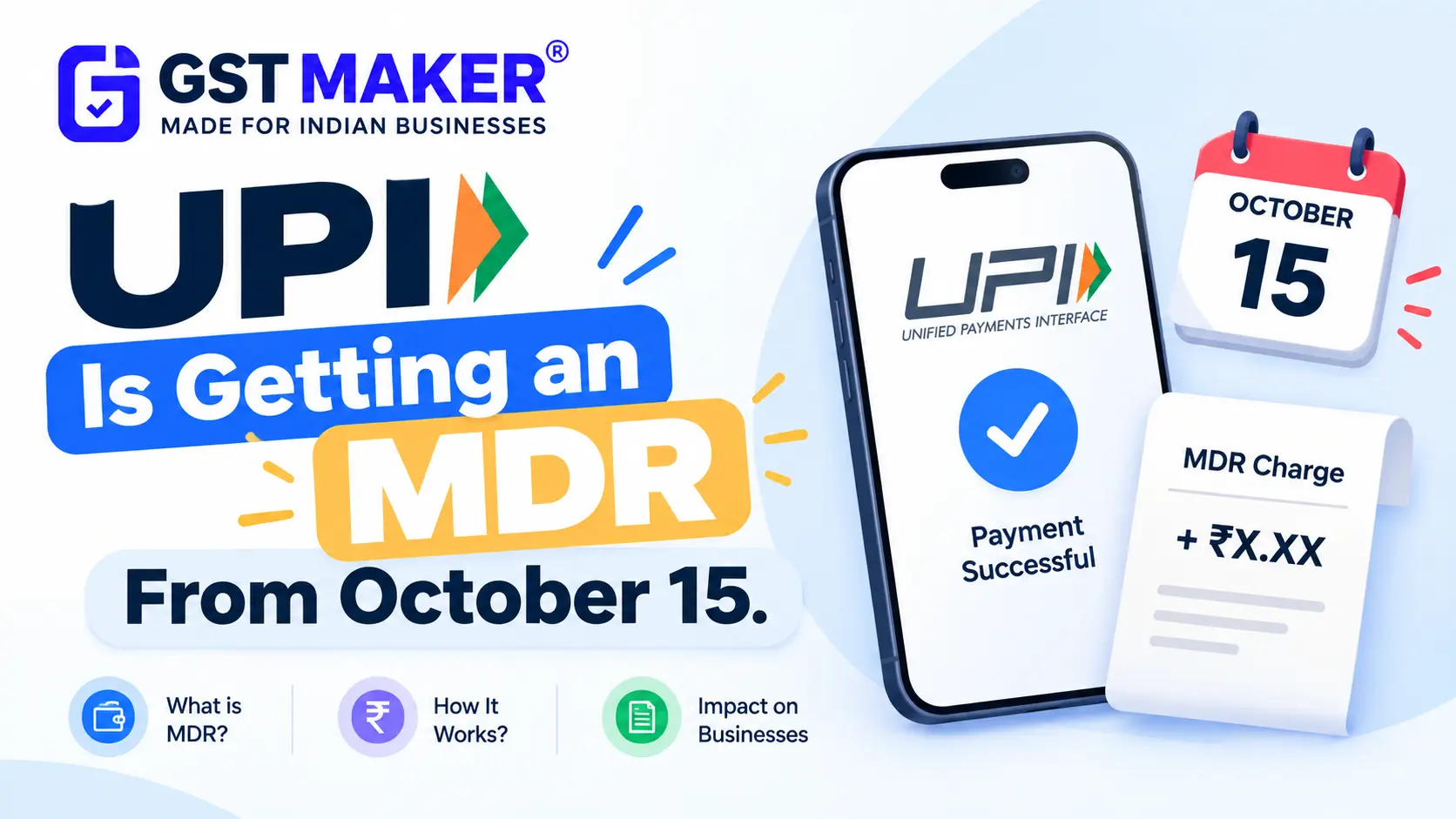
On September 17, 2026, NPCI — the organisation that runs UPI — officially announced that from October 15, a fee will apply to certain UPI payments at merchant stores. It is called MDR. Merchant Discount Rate.
For six years, UPI has been free. No fee for customers. No fee for merchants. That is why it took off the way it did — a street food stall in Varanasi accepts UPI as easily as a mall in Mumbai. No transaction cost meant no barrier.
That changes in three weeks.
But here is the thing — the way this has been reported has created a lot of panic that is not fully justified. Most small businesses will not pay anything. Most transactions will stay exactly as they are. And the merchants who will pay — if they are GST registered — have a way to recover part of that cost.
Let me explain all of this simply, because the confusion right now is real.
What is MDR?
MDR stands for Merchant Discount Rate. It is a fee that a merchant pays for accepting a digital payment.
You have seen this with credit cards. When a shop accepts a Visa or Mastercard payment, the shop pays a small percentage of the transaction value to the bank and the card network. That percentage is the MDR.
UPI never had this. The government waived MDR on UPI in January 2020 specifically to encourage digital payments across India. Merchants accepted UPI at zero cost. That policy ran for nearly seven years.
Now, for the first time since 2020, MDR is coming back — but only for specific transactions, only for certain merchants, and in a very limited form.
What Exactly Is Changing From October 15
Starting October 15, 2026, a 0.4% MDR will apply to UPI payments above ₹2,000 at eligible merchants.
That means if a customer pays ₹5,000 at a merchant through UPI, the merchant pays 0.4% of ₹5,000 — which is ₹20 — as a fee to the payment ecosystem.
There is a cap. For any single transaction above ₹75,000, the maximum MDR is ₹300. So on a ₹1 lakh UPI payment, the merchant pays ₹300 — not ₹400.
The fee goes to the banks and payment apps that process the transaction. Not to the government. Not to NPCI directly. It is a payment infrastructure sustainability fee.
The most important thing to understand: this fee is on the merchant's side. Your customer does not pay anything extra. When someone pays you ₹5,000 through UPI, they still pay exactly ₹5,000. You receive ₹4,980 after the ₹20 MDR is deducted. The customer experience does not change.
Who Is NOT Affected — This Is Most of You
Before worrying about the fee, check whether it even applies to you.
Small merchants are fully exempt.
If your total UPI receipts are less than ₹1 lakh per month, you fall in the P2PM category — Person to Person Merchant. This covers kirana stores, small vendors, street food stalls, local shops, autorickshaw drivers, small service providers. Zero MDR. No change from today.
Transactions under ₹2,000 are fully exempt.
If a customer pays you ₹500, ₹800, ₹1,500 — anything under ₹2,000 — there is zero MDR on that payment. The ₹2,000 threshold is per transaction, not cumulative.
Here is a number that NPCI released: over 96% of all UPI merchant transactions by volume are either under ₹2,000 or made to small merchants who are exempt. Only 4% of merchant transactions by volume will actually attract MDR.
Person to Person payments are completely free.
Sending money to a friend, paying rent to a landlord, splitting a bill — P2P payments have no MDR and will not have MDR. This applies to any amount. ₹10 or ₹10 lakh — if it is going to an individual's bank account, it stays free.
Who Is Affected
The MDR applies to merchants who receive more than ₹1 lakh per month through UPI and accept payments above ₹2,000 per transaction.
In practice, this means medium and large merchants — organised retail, electronics stores, restaurants with higher ticket sizes, service businesses with larger invoices, hotels, clinics with higher consultation fees, and so on.
If your average transaction is above ₹2,000 and your monthly UPI volume is above ₹1 lakh — the MDR applies to the transactions above ₹2,000.
Let us put some real numbers to this.
A home appliance shop receives ₹3 lakh per month through UPI. Most of these are big-ticket purchases — refrigerators, washing machines — so most transactions are above ₹2,000.
If transactions above ₹2,000 total ₹2.5 lakh in the month, the MDR at 0.4% on that portion is ₹1,000 for the month.
₹1,000 on ₹3 lakh in revenue. That is 0.033% of revenue. Not nothing. But not catastrophic either.
The GST Part — This Is Where It Gets Interesting
On top of the 0.4% MDR, the government will charge 18% GST on the MDR fee.
Wait — before you panic, read this carefully.
GST applies to the MDR amount — not to the full transaction. Let me show you with the same example.
Transaction: ₹5,000 MDR (0.4%): ₹20 GST on MDR (18% of ₹20): ₹3.60 Total deducted from merchant: ₹23.60 Merchant receives: ₹4,976.40
So the full deduction on a ₹5,000 transaction is ₹23.60 — not ₹200, not ₹900. GST applies to the ₹20 fee, not the ₹5,000 payment. That distinction matters enormously and has been badly communicated in most news coverage.
Now here is the interesting part for GST-registered businesses.
The GST you pay on the MDR — ₹3.60 in this example — is a GST payment on a service you received. And if you are a GST-registered merchant with output tax liability, you can claim that ₹3.60 as Input Tax Credit.
Over the course of a month with significant UPI volume, the GST on MDR adds up — and a GST-registered merchant can offset it against the GST they owe on their own sales. The net impact is reduced.
For unregistered merchants — those below the GST threshold — the GST on MDR is a real cost with no offset. But given that merchants below ₹1 lakh monthly UPI volume are exempt from MDR entirely, the businesses most likely to face GST on MDR are also the ones most likely to be GST-registered with output tax to offset against.
The U-Turn Story — And Why It Matters
There is something worth acknowledging here, because a lot of merchants are confused and frustrated about it.
In June 2025, the Finance Ministry issued an official statement calling reports about MDR on UPI "completely false, baseless, and misleading." They said they remained "fully committed to promoting digital payments via UPI." Those were their exact words on their official X account.
Fifteen months later, the same government allowed NPCI to implement exactly what it called false and baseless.
What changed? The honest answer is financial sustainability pressure from banks and payment companies. Running the UPI infrastructure at zero MDR costs money — a lot of it. The industry had been lobbying since 2023. The Payments Council of India wrote a letter to the Prime Minister in March 2025 pointing out that ₹1,500 crore in government incentives covered only a fraction of the estimated ₹10,000 crore annual cost of maintaining UPI.
Eventually, the economics won. The government reframed it as a sustainability measure, exempted small merchants and low-value transactions, and set the rate low enough that the impact would be limited.
You can agree or disagree with the decision. But knowing the context helps you understand that this is not a random tax grab. It is a structural change to how payment infrastructure is funded in India — one that was eventually going to happen.
What This Means for You Practically
Here are the straightforward answers depending on your situation.
You are a small shop, vendor, or service provider with UPI receipts under ₹1 lakh per month. Nothing changes for you. Zero MDR. Your customers continue to pay the same way.
Your transactions are mostly under ₹2,000. Nothing changes. Street food, tea stalls, grocery items, small retail — these stay free.
You are a medium or large merchant with transactions frequently above ₹2,000. From October 15, expect a small deduction per eligible transaction. At 0.4%, on a ₹3,000 transaction, that is ₹12. On a ₹10,000 transaction, that is ₹40.
If you are GST registered, track the GST on MDR you are paying — your bank or payment app statement will show this. Claim it as ITC in your GSTR-3B. It will offset your output tax liability.
You are a merchant thinking of passing the MDR cost to customers. You cannot. NPCI and the Finance Ministry have both explicitly stated that merchants are not allowed to pass the MDR charge to consumers as a separate fee. You absorb the cost or build it into your pricing overall — you cannot add a "UPI surcharge" to individual transactions.
You take mostly cash and some UPI. Your cash transactions are unaffected. For UPI, apply the thresholds above.
One More Thing — Will This Reduce UPI Usage?
This is the bigger question that economists and policy analysts are debating.
The concern is that merchants who now face MDR might discourage UPI payments — asking customers to pay cash instead for large transactions. This would be a reversal of years of digital payment habit-building.
The counterargument is that 0.4% is low enough that most merchants will absorb it without changing behaviour. Credit card MDR in India runs at 1.5–2.5% and merchants still accept cards. 0.4% on selected UPI transactions is significantly less.
What actually happens will depend on merchant behaviour at the ground level. If a grocery store starts saying "cash only for bills above ₹2,000," that is a real setback. If they absorb the small fee and continue accepting UPI — which most analysts expect for legitimate businesses — the impact on digital payment adoption will be limited.
What to Do Right Now
If your business is large enough to be affected:
Talk to your bank or payment gateway and ask them to show you what MDR will look like on your statement from October 15. Understand exactly which transactions will attract the fee.
If you are GST registered, set up a way to track the GST on MDR separately. This is ITC you are entitled to claim, and it should not be left unclaimed.
Review your pricing. If MDR is going to be a meaningful cost for your business, now is the time to adjust prices — before October 15, not after.
If you are a small merchant under ₹1 lakh monthly UPI volume — do not change anything. You are exempt.
One practical note: as UPI payments to your business now involve deductions before you receive the money, keeping your invoice records and actual receipts reconciled is more important than before. What you invoice and what hits your bank account will sometimes differ slightly.
👉 GST Maker keeps your invoices and business records organised — free at gstmaker.com
When payment systems get more complex, clean records matter more.