AI Article Assistant
Ask questions, summarize, or extract key takeaways from this article.
The Government Is Using AI to Watch Your GST. Here Is What That Actually Means for Your Business.
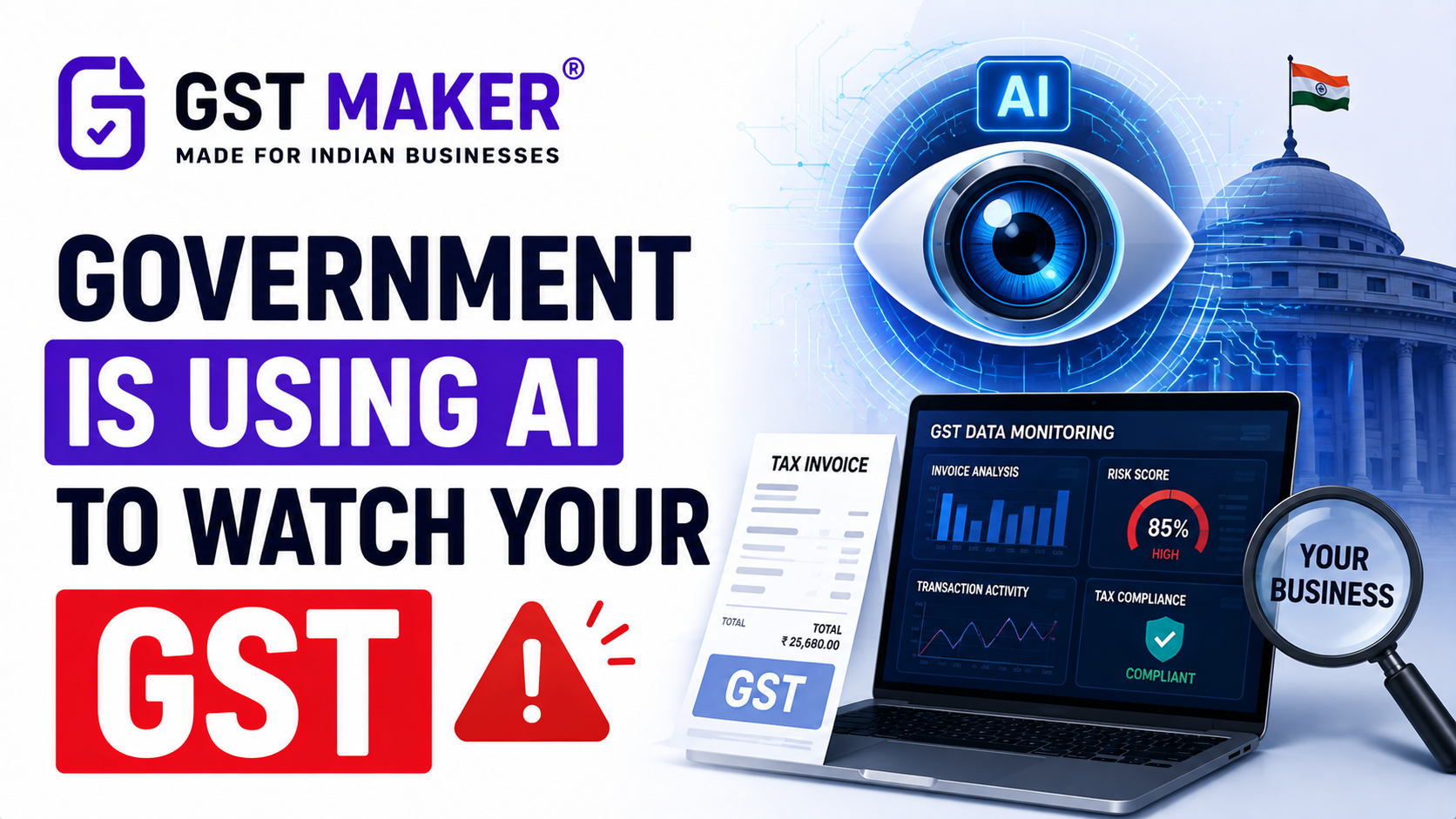
In FY 2025-26, India's GST authorities detected ₹74,782 crore worth of fake ITC fraud.
Let that number sit for a second. ₹74,782 crore. In a single financial year.
The officials who announced this were careful to add something important — this does not mean GST fraud suddenly exploded. It means the government got dramatically better at finding it. AI-powered detection systems caught fraudulent invoice networks and shell companies that were previously invisible to manual audit processes.
That is the shift that is happening right now in Indian taxation. And most honest, compliant small businesses do not fully understand what it means for them.
What the Government Has Actually Built
The GSTN — the technology backbone of India's GST system — processes 3 billion API calls every month. That is not a typo. Three billion. It makes GSTN one of the largest transaction processing systems in the world, comparable to major global financial networks.
Running on top of this infrastructure are AI tools most business owners have never heard of.
BIFA — Business Intelligence and Fraud Analytics. This system builds risk profiles for every registered taxpayer based on filing history, ITC claim patterns, turnover trends, and how your numbers compare to others in the same industry. If a textile trader in Surat is claiming ITC at a rate significantly higher than the average for textile traders — BIFA notices.
ADVAIT — Advanced Analytics for GST. This goes deeper, doing real-time reconciliation across GSTR-1, GSTR-2B, and GSTR-3B filings to flag anomalies. Not just your filings in isolation — your filings in the context of your entire supplier and buyer network.
There is also Project Bhuvan-GST, which uses satellite data to cross-reference business activity with declared turnover. A warehouse visible from satellite imagery, with regular truck movement, filed by a business showing minimal turnover — that creates a flag.
These are not hypothetical future systems. They are operational today.
Why Compliant Businesses Should Pay Attention Too
Here is what I want to be direct about, because most articles on this topic either write it for fraudsters or write it in a way that makes honest businesses feel accused of something.
If you are running a clean business — proper invoices, correct GST rates, returns filed on time — AI surveillance is not a threat. It is actually a good thing for you. It levels the playing field. The competitors who were undercutting you by claiming fake ITC and not declaring full turnover are getting caught at scale.
But there are ways honest businesses get caught in the net anyway.
The supplier problem. If one of your regular suppliers has been flagged as high-risk in BIFA's system — because of their filing patterns, their network connections, or an investigation into their sector — your ITC claims from that supplier attract automated scrutiny. You did nothing wrong. But you are connected to a flagged entity in the system's graph.
The outlier problem. AI systems work on averages and deviations. If your ITC-to-turnover ratio looks unusual compared to your industry peers — even if there is a perfectly legitimate explanation — it creates a risk flag. An AI does not know that you had unusually high equipment purchases this year because you upgraded your entire studio setup. It just sees a number that deviates from the norm.
The data quality problem. Errors in your own filings — wrong GSTINs, wrong invoice values that got corrected, inconsistencies between returns — create patterns in the data that look, to an automated system, similar to the patterns that fraudulent businesses create. Not identical. But similar enough to attract attention.
The single best protection against all three is exactly what good compliance looks like anyway: clean invoices, correct data, timely filings, and organised records that can be explained quickly if anyone asks.
The IMS and AI — How They Connect
The Invoice Management System that became effectively mandatory from April 2026 is not just a compliance tool. It is a data collection mechanism.
Every action you take in IMS — every invoice you accept, reject, or leave pending — is data. The government can see not just what invoices were filed, but how quickly you reviewed them, which ones you rejected, and whether your acceptance patterns match what would be expected given your declared business activity.
A business that never rejects any invoices in IMS, no matter what gets filed against their GSTIN, creates a different risk profile than a business that actively reviews and occasionally rejects incorrect invoices. The first pattern looks like someone who is not paying attention — or someone who does not mind what appears in their GSTR-2B.
The AI systems are learning from this behavioral data too. Not just the invoice values. The behavior around the invoices.
This is why the advice to "check IMS weekly" is not just about keeping your ITC clean. It is about creating a behavioral record that looks like what a legitimate, attentive business looks like.
What Is Changing for CAs and Tax Professionals
The role of a CA in GST compliance is shifting in a way that is uncomfortable for some in the profession to acknowledge publicly.
The mechanical parts of compliance — data entry, return preparation, basic reconciliation — are being automated faster than most people expected. Not replaced entirely, but substantially compressed. Software that used to need an experienced operator now needs a less experienced one. Reconciliation that used to take a day now takes an hour with the right tools.
What AI cannot replace is judgment. When an automated system sends a notice because your numbers look unusual, you need a CA who understands the context — why the numbers look the way they do, how to respond, what documentation to present. When a new notification comes out changing the rules for a specific sector, you need someone who reads it, understands the implications for your specific business, and tells you what to do.
The CAs who are adapting to this are using AI tools to handle the mechanical work faster, freeing themselves for the higher-value advisory work. The ones who are not adapting are finding that clients are increasingly asking why they need to pay for something that software can do.
For small businesses, this means the cost of basic GST compliance is going to come down over the next few years. Automated reconciliation tools, AI-driven return preparation, and real-time ITC tracking are all becoming more accessible and less expensive.
The cost of getting compliance wrong, on the other hand, is going up. Because the systems catching errors are getting better.
The Three Things AI Cannot Do — Yet
For balance, because this topic sometimes gets overhyped in both directions.
AI can find patterns. It cannot evaluate context. An automated system can flag that your turnover dropped 40% this year. It cannot know that you lost your biggest client in January and spent six months rebuilding. That explanation requires a human conversation, which is why notices still go to real people and responses go back to real people.
AI can detect anomalies across large datasets. It struggles with legitimate edge cases at scale. Small businesses with unusual but legitimate structures — a freelancer who also sells handmade goods, a consultant who occasionally takes equity instead of fees — create data patterns that outlier detection systems find genuinely difficult to classify correctly.
AI can automate what has been seen before. It is less good at the novel fraud. The sophisticated operators know this. They are constantly testing the edges of what detection systems catch. The cat-and-mouse game between tax authorities and sophisticated fraudsters is not ending — it is just moving to a more technical level.
This matters for policy reasons, but for most small businesses it is background noise. The fraud that AI is catching at scale is not sophisticated — it is volume. Thousands of shell companies, simple fake invoices, obvious circular transactions. That is where the ₹74,782 crore came from.
What This Means for How You Run Your Business
Practically — and this is the part most people actually want — what do you need to do differently given that AI is now actively watching GST filings?
Nothing dramatic, if you were already doing things right.
File on time, every time. Late filings create patterns that risk-scoring systems notice. A business that files GSTR-1 at 11:58 PM on the due date every single month looks different from one that files at 3 PM on the 9th. Not necessarily a red flag on its own. But in combination with other signals, it contributes to a risk profile.
Make sure your supplier network is compliant. Ask your regular suppliers directly whether they file on time. Check GSTR-2B carefully — if a supplier's invoices consistently do not appear there, that is a signal worth acting on. The ITC hard block means it affects your ability to file anyway. But the risk profile angle is an additional reason.
Keep your invoice data clean and consistent. The same GSTIN, the same address, the same invoice number format, consistent with what you declared last year. Unexplained inconsistencies are what anomaly detection looks for. Explainable, documented changes — a new business address, a GSTIN update — are fine as long as they are properly recorded.
Review IMS weekly, not monthly. For reasons covered above — the behavioral data matters as much as the invoice data.
And keep records. If an automated notice ever does arrive, the question is not whether you did something wrong. The question is whether you can show, quickly and clearly, that you did not. Organised invoice records and clean GSTR-1 data are what make that conversation short.
The Bigger Picture
India's GST system has grown from 66.5 lakh registered taxpayers at launch in 2017 to 1.6 crore in 2026. The volume of transactions the system handles has grown proportionally. Manual audit and compliance checking at this scale is simply impossible.
AI is not a choice in this context. It is an engineering necessity. The government had to build it or abandon any serious attempt at compliance enforcement.
The result is a system that is significantly smarter and faster than the one that existed even two years ago. And it is going to keep getting smarter. The GSTN AI Hackathon in 2024 released 900,000 anonymized taxpayer records specifically to develop better fraud prediction models. That work is finding its way into production systems now.
For honest businesses, the trajectory is good. Compliance is getting easier through automation. Fraud by competitors is getting harder. The playing field is slowly leveling.
The prerequisite is that your own data is clean. Every invoice correctly issued. Every return filed accurately and on time. Every ITC claim backed by a supplier who also filed.
That is what AI-era GST compliance looks like. Not dramatically different from good compliance always looked like. Just with less margin for the errors that used to be forgiven through manual processes and follow-up notices.
The billing side of this — correct invoices, correct tax types, GSTR-1 ready data — is what GST Maker handles automatically.
In a system where AI is watching invoice patterns, getting the basics right on every single invoice is not optional anymore.