AI Article Assistant
Ask questions, summarize, or extract key takeaways from this article.
India's 30-Day Invoice Rule Is Already Catching People Out. Here Is Everything You Need to Know.
Let me tell you about a textile trader in Surat.
He runs a wholesale business. Good turnover — well above ₹10 crore annually. He has always issued invoices the way traders in his industry do: goods move, delivery happens, paperwork gets reconciled at the end of the week or sometimes at month end. That is just how the industry works. It always has.
In May 2025, he raised an invoice on the 3rd. By the time his accounts person sat down to upload it to the IRP and generate an IRN — it was the 6th of June. 33 days had passed.
The portal rejected it. No IRN. No QR code. The invoice he had already sent to his buyer was legally invalid.
His buyer could not claim ITC on it. The buyer's accounts team called. An awkward conversation followed. A fresh invoice had to be raised with a new date — which created its own complications with the buyer's purchase records and the delivery documentation that had already been filed.
All of this because of 3 days.
What the 30-Day Rule Actually Says
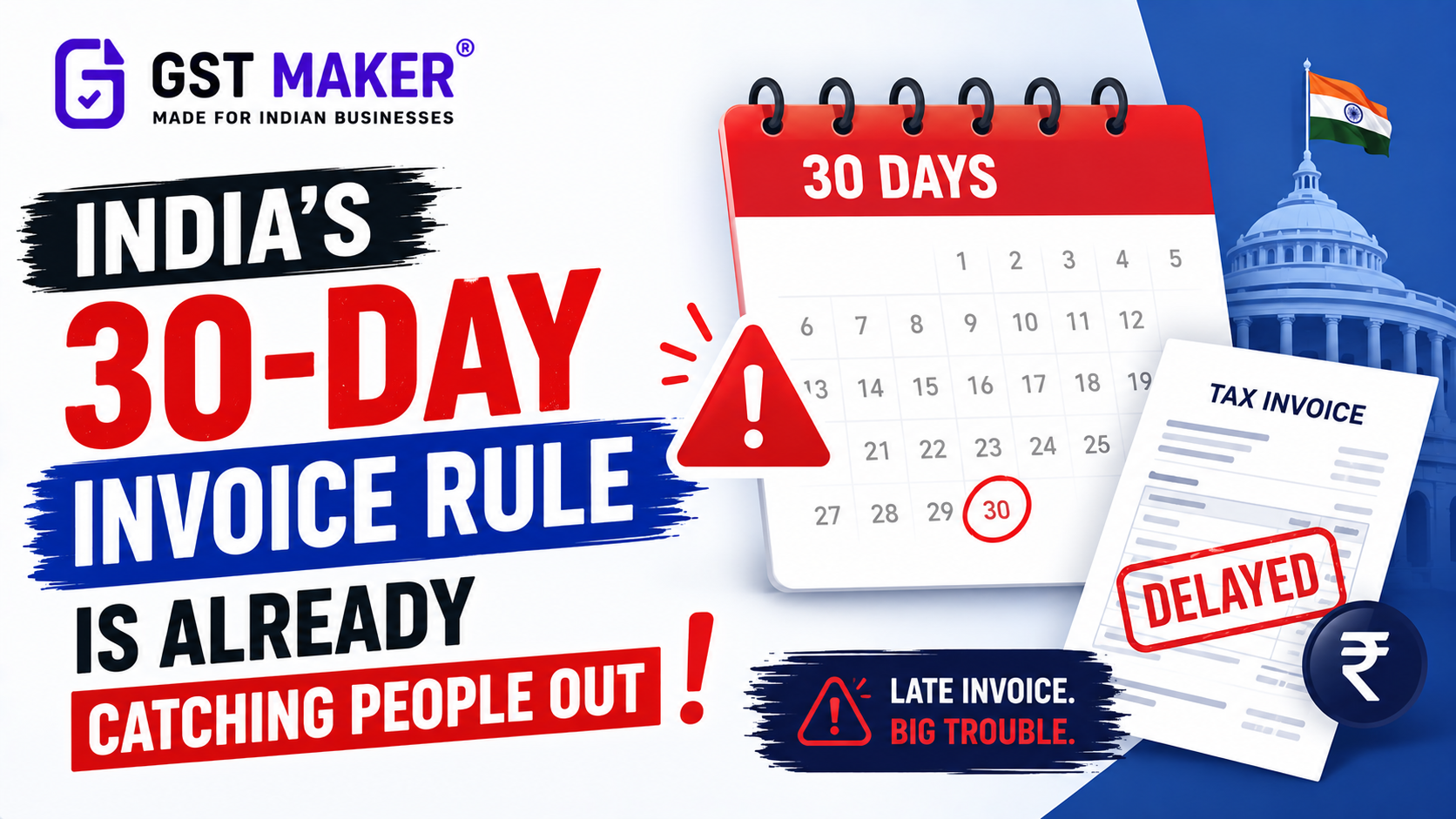
From April 1, 2025, any business with aggregate annual turnover above ₹10 crore must upload their B2B invoices, credit notes, and debit notes to the Invoice Registration Portal within 30 days of the invoice date.
Not 30 days from when you get around to it. 30 days from the date printed on the document.
If the invoice is dated August 1, it must reach the IRP by August 30. Miss that and the IRP permanently blocks IRN generation for that specific invoice. There is no extension request. There is no appeal process. There is no back door. The window closes and it does not reopen.
The penalty for a missing e-invoice — one that should have had an IRN but does not — is ₹10,000 per invoice or 100% of the tax due, whichever is higher. For a ₹5 lakh invoice with 18% GST, that is ₹90,000 in potential penalty. Per invoice.
Who Does This Apply To Right Now?
This is the question most people ask first and it is worth being precise about.
The 30-day window currently applies to businesses with aggregate annual turnover above ₹10 crore. The word "aggregate" is important here — it is calculated at PAN level, adding up turnover across every GSTIN registered under the same PAN. If you have two business registrations under one PAN and their combined turnover crosses ₹10 crore, both are covered.
The mandatory e-invoicing threshold itself — the requirement to generate IRNs at all — sits at ₹5 crore as of August 2023 and remains there as of mid-2026. So:
Above ₹10 crore: e-invoicing mandatory, 30-day upload rule applies. Between ₹5 crore and ₹10 crore: e-invoicing mandatory, no 30-day rule yet. Below ₹5 crore: e-invoicing not mandatory currently.
The threshold has dropped from ₹500 crore in October 2020 to ₹5 crore in August 2023. That is a 100x reduction in six years. The trajectory is one direction. The 30-day rule will likely follow the same path — currently at ₹10 crore, almost certain to come down further.
Why This Is Catching Businesses Off Guard
The 30-day rule is not new. It has been in place since April 2025. But it is still catching businesses out because of how invoicing actually works in practice.
Many Indian businesses — especially in manufacturing, trading, and distribution — do not invoice in real time. Goods move. Delivery challans go with the truck. The actual invoice gets raised later, after the buyer confirms receipt, or after a batch of deliveries are consolidated, or when the accounts team processes the week's transactions.
In some sectors — textiles, commodities, agriculture-linked businesses — week-old or even month-old invoicing has been completely normal practice for decades. It is not laziness. It is how the supply chain is structured.
The 30-day rule does not care about industry practice. It runs from the date on the invoice, not from the date you decide to formalise things. Which means businesses that have always batched their invoicing now need to either change that process or be extremely careful about what dates they put on invoices.
And this is where it gets complicated.
The Backdating Problem
Here is the practical issue nobody talks about clearly.
Say goods are delivered on the 2nd. The buyer signs a delivery challan. Your accounts team raises the invoice on the 15th, backdated to the 2nd to match the delivery date. This is common practice. The invoice date matches the economic reality of when the transaction happened.
Under the 30-day rule, that invoice dated the 2nd must now be uploaded by the 2nd of the following month. But your accounts team raised it on the 15th and planned to upload it with the month's batch at month end. By the time they get to it — if it is a large company with a lot of transactions — the window may already be tight.
For businesses that routinely backdate invoices to delivery dates, the 30-day rule has effectively moved the compliance clock backward. The date on the invoice, not the date you raised it, is what matters.
The practical adjustment: invoice date and IRN generation need to happen much closer together than before. Ideally same-day or within a few days of the actual transaction.
What Happens to Your Buyer When You Miss the Window
This is the part that creates business relationship damage, not just compliance issues.
When you miss the 30-day window and cannot get an IRN for an invoice, your buyer receives a document that is not legally valid as a tax invoice. They cannot claim ITC on it. Their GSTR-2B will not show it.
Under the new ITC hard block system that came into effect from April 2026, this directly prevents them from filing their own GSTR-3B without first resolving the mismatch. They are blocked. They call you.
From the buyer's perspective, they received goods, they expected to claim ITC, and now because of an administrative error on your end, they cannot. For large buyers who deal with many vendors, a vendor who creates recurring ITC complications gets replaced by one who does not.
The business cost of consistently missing the 30-day window is not just penalty risk. It is buyer relationships.
The Credit Note and Debit Note Detail Most People Miss
The 30-day rule applies to credit notes and debit notes too, not just tax invoices.
This is the detail that catches businesses who have managed to get their invoice process sorted but have not updated their credit note workflow.
A credit note issued on the 5th of the month must be uploaded to the IRP within 30 days — by the 4th of the following month. If you process credits in a batch at the end of the month, credit notes from the first week of the month can slip past 30 days before you realise.
Worth reviewing: if your team handles credit notes separately from invoices, and they are processed on a different schedule, check that the schedule accounts for the 30-day window on every document type.
The Practical Fix — Real-Time IRN Generation
The cleanest solution is the one that sounds simplest: generate the IRN at the moment you raise the invoice.
Not in a batch at week end. Not when the accounts team has time. At the moment the invoice is created.
Modern billing and ERP software that integrates directly with the IRP via API can do this automatically. You raise the invoice in your software, the system sends it to the IRP in real time, and the IRN and QR code come back and are embedded in the PDF before it is sent to the buyer. The whole process is invisible — it happens in seconds.
For businesses that are still manually uploading invoices to the IRP — logging into the portal, downloading the JSON, uploading, retrieving the IRN — the manual process itself is the risk. Every step where a human has to remember to do something is a step where the deadline can slip.
If your turnover is above ₹10 crore and you are still on a manual or semi-manual e-invoicing process, that is the first thing to fix.
What This Means If You Are Below ₹5 Crore
Technically, nothing changes for you today.
But pay attention to the trajectory. The e-invoicing threshold dropped from ₹500 crore to ₹5 crore in six years. The 30-day rule is currently at ₹10 crore but will almost certainly follow the same path downward.
There are also indirect effects already. If your buyers are large companies above ₹10 crore, they are now under stricter timelines. They need your invoices to be correct and submitted to them quickly so they can get their IRN process done. The downstream pressure from your buyers' compliance requirements is real even when you are not directly covered.
More practically: the habits that make the 30-day rule manageable — issuing invoices the same day as the transaction, keeping billing records clean and current, not batching paperwork — are good habits regardless of which threshold you sit under. Building them now is easier than scrambling to build them under deadline pressure.
One More Thing — The IRN Cancellation Window
If you generate an IRN and then realise there is an error — wrong amount, wrong GSTIN, something that needs to be corrected — you have exactly 24 hours to cancel it on the IRP.
After 24 hours, the IRN cannot be cancelled. You are stuck with that invoice reference in the system. Your only option is to issue a credit note against it and raise a fresh correct invoice.
For businesses that generate IRNs in real time through software, catching these errors within 24 hours is manageable. For businesses that batch uploads and only check everything the next day — 24 hours is a tight window that easy to miss.
The 24-hour cancellation window and the 30-day upload window are two different timelines to track. Both have hard consequences when missed.
The Bigger Picture
India's e-invoicing system has reached 94% of B2B transaction value. That number from the GSTN reflects how comprehensively the system now covers the formal economy.
The 30-day rule is part of a broader move toward real-time compliance. The government wants invoice data in the system at the time of the transaction, not weeks later. IMS, the ITC hard block, the locked GSTR-3B fields — all of it pushes in the same direction. The gap between when a transaction happens and when it appears in the compliance system is shrinking.
For businesses that have been operating with comfortable delays in their paperwork, the adjustment is real. Not punitive — the rules are the same for everyone. But it requires changing workflows that have been in place for years.
The textile trader in Surat sorted it eventually. He moved his accounts team to same-day invoice processing and IRN generation through integrated software. It required about three weeks of internal adjustment. His buyer relationships stabilised. He has not missed a window since.
Three weeks of adjustment to prevent ongoing ITC complications with buyers and exposure to ₹10,000-per-invoice penalties is, by any reasonable calculation, worth it.
GST Maker is designed to keep your billing clean and compliant — correct GST types, sequential invoice numbers, and GSTR-1 ready data automatically.
The billing side should not be where compliance breaks down.